

On page 185 of The Resurrection of the Dead, Gary DeMar states a rule: “We have no call and no right to attack and derisively label one another because we might disagree with each other on these difficult eschatological matters, particularly the doctrine of the resurrection of the dead.”1
The rule assumes that the resurrection of the dead is one of those “difficult” matters on which Christians may simply agree to disagree. Scripture says otherwise. Hebrews lists “the resurrection of the dead” among “the elementary doctrine of Christ,” part of the “foundation” with repentance and faith (Heb. 6:1-2).2 And Paul did not treat its denial as a difficult matter. He named Hymenaeus and Philetus, who were “saying that the resurrection has already happened,” and said their teaching “will spread like gangrene” (2 Tim. 2:17-18). But set that aside and hold the book to its own rule. It does not keep it.
Long before page 185, Kim Burgess has charged the English translators of 1 Corinthians 15:26 with changing the tense “deliberately,” and adds, “To me, it borders on deceit” (61). On the same page he says that “one does not necessarily want to say ‘incompetence’ here,” which is a way of saying it. Three pages later, scholars who take Sheol to mean the grave are making a “sly, and, to me, deceitful attempt” (64). Four pages after that, the Westminster Assembly suffers from “crippling self-imposed theological blindness” (68). Those who place 1 Thessalonians 4 and Revelation 20 in the future are guilty of “sheer foolishness,” and Burgess adds, “whether this is forgivable or not is another matter” (115). The confessions are “shoddy and weak,” and those who endorse them endorse “incompetence” (143).
After page 185 nothing changes. Taking the “last day” as the last day of history is “simply crazy” (265). On the next page, DeMar himself, the man who wrote the rule, says that placing 2 Thessalonians 1 in the future “is insanity!” (266).
Deceit, blindness, incompetence, foolishness that may not be forgivable, craziness, insanity. Every one of these labels is about the mind or the heart of the man who disagrees with Burgess and DeMar. Burgess does not say the translators are wrong; he says they are dishonest. He does not say Westminster misread John 3:13; he says it blinded itself. He does not only say futurists err; he asks whether they can be forgiven.
There is one label they do object to. On the same page where Burgess calls the confessions incompetent, he complains that those who hold them “go on and charge others with ‘heresy’” (143). But that word is not a judgment of motive. Heresy names a doctrine that contradicts what the church confesses from Scripture, and a denial that the body laid in the grave will be raised is exactly that (WCF 32.2; LC 87). To call a teaching heresy is to measure it against the church’s confession. To call a man deceitful is to claim to see his heart. Burgess and DeMar have it completely backwards: they forbid the first and practice the second.
William S. Plumer described this pattern in the nineteenth century. Of false teachers he wrote: “Then they are fierce and bite with their teeth. Then they set up a loud and idle pretense of great love of peace. But they brook no opposition; and they admit of no neutrality.”3 This book follows that order. First comes the fierceness: deceit, blindness, incompetence, foolishness, craziness. Then comes the plea for peace on page 185. But the plea does not stop them. The insults continue for another eighty pages.
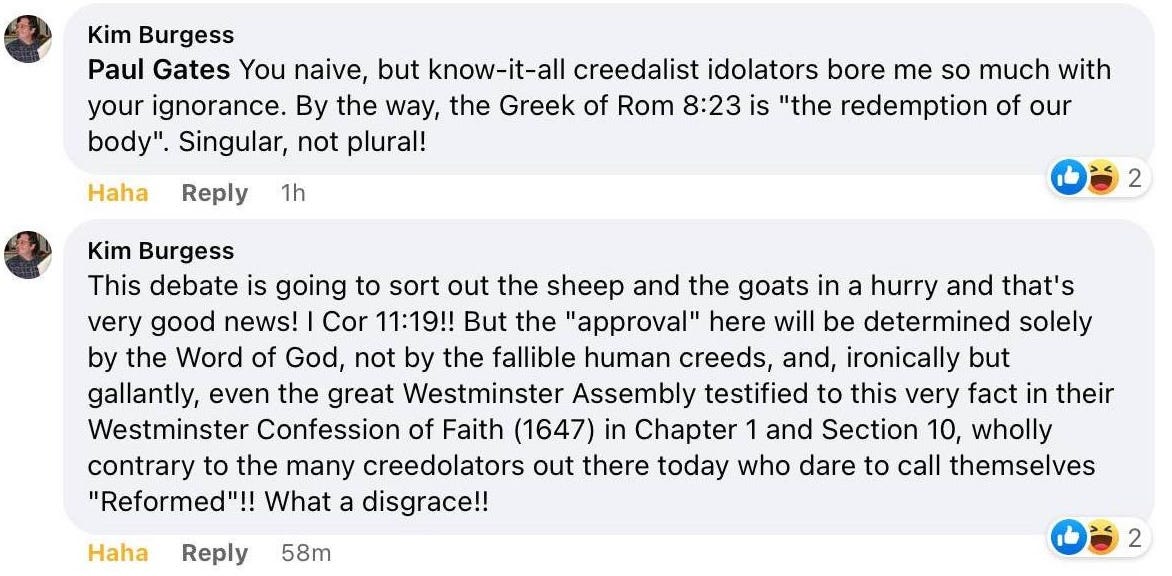
Nor is the pattern new. Years before the book, replying to critics on Facebook, Burgess wrote: “You naive, but know-it-all creedalist idolators bore me so much with your ignorance.” In a second comment he called those who hold to the Westminster Standards “the many creedolators out there today who dare to call themselves ‘Reformed’!! What a disgrace!!”4 That is two labels in two comments from the man who would later coauthor a book that says “we have no call and no right to attack and derisively label one another.”
That second comment opens with this: “This debate is going to sort out the sheep and the goats in a hurry,” followed by a citation of 1 Corinthians 11:19. Separating the sheep from the goats is the Lord’s work at the last judgment (Matt. 25:32-33). Burgess says the debate is doing that work now, and with “creedolators” and “disgrace” in the same comment, he leaves no doubt where he puts his critics. The verse he cites does not help him. Paul writes, “there must be factions among you” (1 Cor. 11:19), and the word is haireseis, which the King James renders “heresies.” Burgess objects when the church uses that word, but he reaches for the verse when it suits him.
Their earlier work is no different. In the second volume of The Hope of Israel and the Nations, published two years before The Resurrection of the Dead, DeMar says of critics who disagree with him on the law, “I don’t think it’s confusion. I really don’t. They are dishonest.” Then he widens it: “Many of those who attack us on the topics of eschatology and law are dishonest.” Translators who render Hebrews 9:11 differently than he does translate the Greek “fraudulently,” and he asks, “What is wrong with these translators?”5 The man who would later write that “we have no call and no right to attack and derisively label one another” had already called his attackers dishonest and the translators fraudulent.
Burgess is worse. Translators and commentators “fudge badly” on Romans 8:23, and on 1 Corinthians 15:26 he warns, “Do not fudge deceitfully.” The church’s tradition is “bogus Church tradition ignorantly passing itself off as ‘orthodoxy,’” and the belief that the saints have lived in the “last hour” for two thousand years is “insane nonsense” that “woeful Church tradition” has driven “otherwise sane theologians to adopt.” What the church calls orthodoxy is “all so sadly absurd.” Its eschatologies are “woefully shoddy excuses” that “she has perversely chosen to embrace,” and they produce “cowardly disobedience.” A view of the Christian life he dislikes is “so pathetic,” and readers who misunderstand him are “sloppy/careless.” Then, in the same volume, he complains about “traditional futurists who want to scream at us because, in their view, we are simply stupid, heretical preterists.”6
So the rule on page 185 is not a principle of charity. It applies only to their critics. It forbids others to call their doctrine heresy while leaving them free to call everyone else deceitful, blind, insane, and goats. Jesus addressed that kind of double standard: “For with the judgment you pronounce you will be judged, and with the measure you use it will be measured to you” (Matt. 7:2).
Burgess and DeMar demand charity from everyone but themselves. They call the church’s translators deceitful, its confessions incompetent, and its teachers blind and insane, and then ask not to be called heretics. The church owes them no such favor. A man who denies that the body laid in the grave will rise denies an article of the faith, and the church has always had a name for that.
Kim Burgess with Gary DeMar, The Resurrection of the Dead: The Mortal Swallowed Up by Life (Powder Springs, GA: American Vision, 2026), 185. Subsequent references to this work are cited parenthetically in the text.
Scripture quotations are from the English Standard Version (ESV).
William S. Plumer, False Doctrines and False Teachers: How to Know Them and How to Treat Them, sec. 4, Grace Gems, accessed November 3, 2026, https://www.gracegems.org/Plumer/false_doctrines.htm.
Kim Burgess, comments on Facebook, n.d.
Kim Burgess with Gary DeMar, The Hope of Israel and the Nations: New Testament Eschatology Accomplished and Applied, vol. 2 (Powder Springs, GA: American Vision, 2024), 118, 339-40.
Burgess, Hope of Israel, vol. 2, 27, 177, 88, 166, 47, 207, 235, 233, 287, 237.