

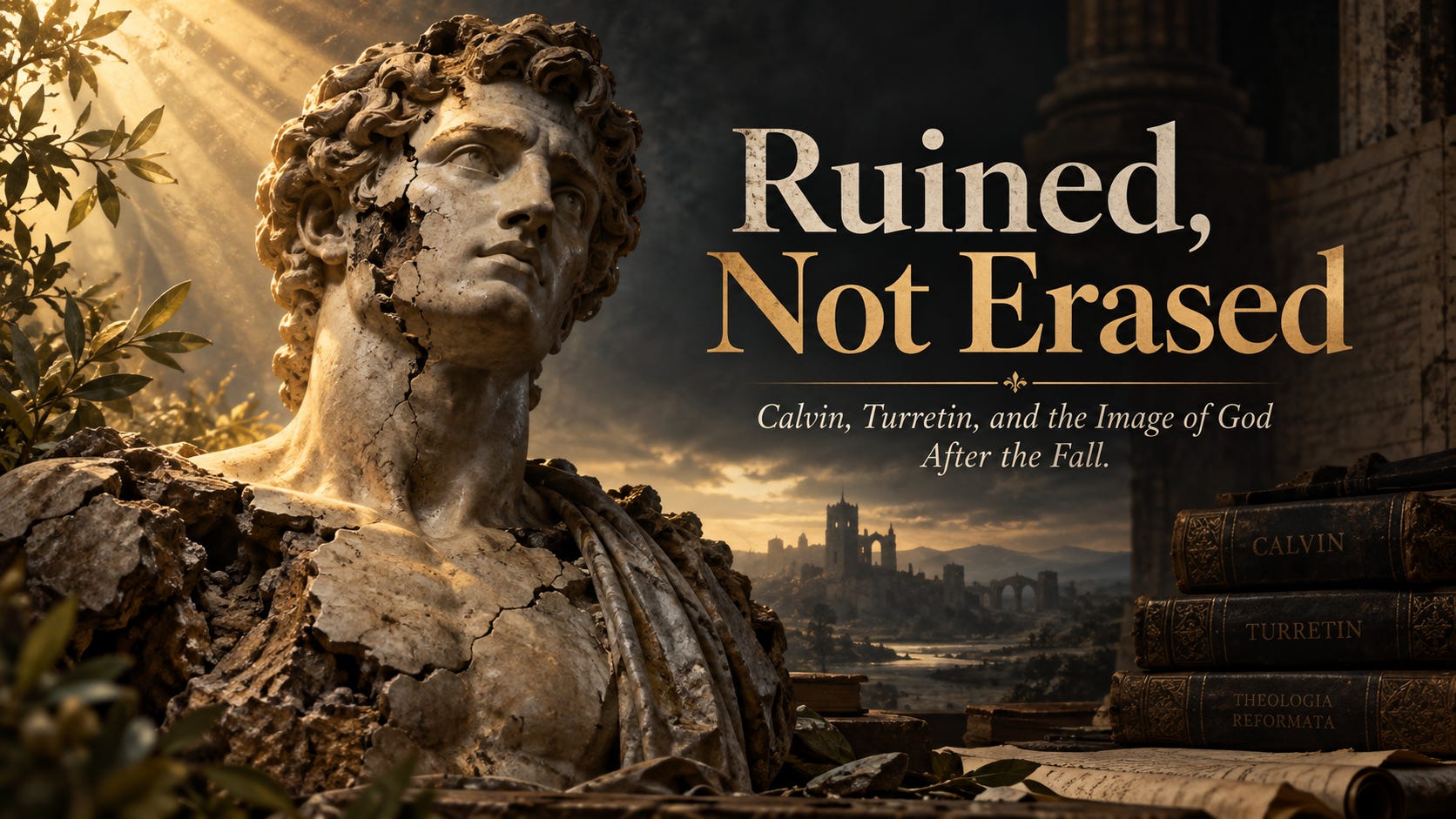
Some who call themselves Reformed now argue that when Adam fell, man lost the image of God completely, so that nothing of it remains in fallen humanity. Some go further and call Calvinists who hold that fallen man still bears the image “heretics.”
That charge should be tested against the sources. If the historic Reformed position is that the image was entirely lost, then those of us who say otherwise have departed from it. But if Calvin, Turretin, and the Reformed confessions all teach that the image was corrupted but not wholly erased, then the charge of heresy is historically reckless.
Taken in context, the sources are not ambiguous about whether remnants of the image remain. The claim persists because its advocates quote one or two strong statements from Calvin out of context and ignore the rest of what he wrote on the subject, sometimes including the next sentence.
What Calvin actually said
Calvin addresses the question directly in the Institutes.1 In 1.15.4 he writes:
It cannot be doubted that when Adam lost his first estate he became alienated from God. Wherefore, although we grant that the image of God was not utterly effaced and destroyed in him, it was, however, so corrupted, that any thing which remains is fearful deformity; and, therefore, our deliverance begins with that renovation which we obtain from Christ, who is, therefore, called the second Adam, because he restores us to true and substantial integrity.
The sentence makes two claims. Calvin denies that the image was “utterly effaced and destroyed,” and he says that what remains is “fearful deformity.” Quoting only the second claim misrepresents him.
Later in the same section Calvin uses stronger language:
Therefore, as the image of God constitutes the entire excellence of human nature, as it shone in Adam before his fall, but was afterwards vitiated and almost destroyed, nothing remaining but a ruin, confused, mutilated, and tainted with impurity, so it is now partly seen in the elect, in so far as they are regenerated by the Spirit.
This passage is sometimes cited as proof that Calvin taught total loss. But he says the image was “almost destroyed,” and he calls what remains “a ruin.” Both terms assume that something is left. That is the Reformed doctrine: something remains, and it is unfit for what it was made to be.
Calvin’s commentaries say the same. On Genesis 9:6 he answers the objection these critics raise:
Should any one object, that this divine image has been obliterated, the solution is easy; first, there yet exists some remnant of it, so that man is possessed of no small dignity; and, secondly, the Celestial Creator himself, however corrupted man may be, still keeps in view the end of his original creation; and according to his example, we ought to consider for what end he created men, and what excellence he has bestowed upon them above the rest of living beings.
Calvin’s answer is direct: “there yet exists some remnant of it.” He says the same on James 3:9:
Were any one to object and say, that the image of God in human nature has been blotted out by the sin of Adam; we must, indeed, confess that it has been miserably deformed, but in such a way that some of its lineaments still appear. Righteousness and rectitude, and the freedom of choosing what is good, have been lost; but many excellent endowments, by which we excel the brutes, still remain. He, then, who truly worships and honours God, will be afraid to speak slanderously of man.
Here Calvin draws the line where the later Reformed tradition drew it. Righteousness, rectitude, and the freedom to choose what is good were lost. The “many excellent endowments, by which we excel the brutes” remain.
How the cherry picking works
The critics do have Calvin quotes, but not all of them. In the argument to his commentary on Genesis 3, Calvin says that man became “entirely changed, and so degenerate, that the image of God, in which he had been formed, was obliterated.” That statement is often quoted. But in the same commentary, at Genesis 9:6, Calvin raises the objection “that this divine image has been obliterated” and answers that a remnant remains. He used “obliterated” of the image with respect to man’s righteousness and communion with God, and he explicitly denied that the word means nothing remains.
He explains his own vocabulary on Genesis 1:26:
But now, although some obscure lineaments of that image are found remaining in us; yet are they so vitiated and maimed, that they may truly be said to be destroyed. For besides the deformity which everywhere appears unsightly, this evil also is added, that no part is free from the infection of sin.
This sentence shows how to read Calvin’s strongest language. When he says the image is “destroyed,” he means the remaining lineaments are so damaged that the word is fitting. He does not mean there are no lineaments. The clause saying some remain comes first in the sentence, so citing its end as proof of total loss requires ignoring its beginning.
The confessions receive the same treatment. The Scots Confession (1560) says that by original sin “was the image of God utterly defaced in man.” That is strong language, and in the English of the period “deface” could mean more than surface damage. But a confession should be read alongside its sister confessions and the theology behind it, and on this point the Reformed churches agree. The Belgic Confession (Article 14) says man “retained only small remains thereof, which, however, are sufficient to leave man without excuse.” The Second Helvetic Confession (Chapter 9) says fallen man’s “understanding indeed was not taken from him, neither was he deprived of will and altogether changed into a stone or stock.” The Canons of Dort (III/IV, Article 4) state: “There remain, however, in man since the fall, the glimmerings of natural light, whereby he retains some knowledge of God, of natural things, and of the difference between good and evil, and shows some regard for virtue and for good outward behavior.” Dort then adds that this light cannot bring anyone to salvation and that man pollutes it by his use of it. The remnants leave man accountable, but they cannot save him.
How Turretin put it all together
Calvin often wrote as a preacher and commentator. Francis Turretin wrote systematic theology, and in his Institutes of Elenctic Theology (Topic 5, Question 10)2 he supplied the distinctions that explain how Calvin could say both “obliterated” and “remnant.”
Turretin says the image consisted in three things: “Antecedently in nature (as to the spirituality and immortality of the soul); formally in rectitude or original righteousness; consequently in the dominion and immortality of the whole man” (5.10.6).
The fall affected these differently. Original righteousness, the formal and principal part of the image, was lost entirely. The soul’s nature, with its intellect and will, remains but is corrupted. Dominion was “very much broken and diminished, yet it did not on that account wholly perish,” as its reconfirmation to Noah in Genesis 9:2 and 3 shows (5.10.22).
Turretin grounds the remaining image in the same texts Calvin used:
Hence man even after sin is said to be made in the image of God (Jam. 3:9), and the killing of man is called the destruction of the image of God (Gen. 9:6). In the latter, the killing of man made after the image of God is forbidden, which could not be said unless a certain part of the divine image was implanted in the very nature of the soul. (5.10.7)
He then explains why Scripture, and Calvin with it, often speaks of the image as righteousness:
If Scripture refers the image of God more often to righteousness and holiness (because these are its best parts), it does not on that account speak to the exclusion of it and deny that it also pertains to the soul itself. Nor is it absurd that the image should be said to be partly lost and partly conserved. (5.10.7)
That sentence makes Turretin’s position unmistakable. The image is “partly lost and partly conserved.” He even says that in fallen man the image of God and the image of the devil exist together in different respects: God’s image in the essence of the soul and the gifts that remain, the devil’s in depravity and pollution.
His summary of Adam after the fall:
Adam after his fall had the image still (as also his posterity even now have), since they are said to be made after the image of God. Yet this must be understood only relatively (as to certain natural remains of that image) and not absolutely (as to spiritual and supernatural qualities which are evidently lost and must be restored to us by the grace of regeneration). (5.10.16)
Some will point to Turretin’s later question, “Whether Adam by his fall lost the image of God,” which he answers, “We affirm.” But Turretin defines his terms first. He is not speaking “generally” of all of man’s created gifts, nor of “certain remains of it existing in the mind and heart of man after the fall (in which sense we understand Gen. 9:6 and Jam. 3:9).” Rather, “we understand it strictly of the principal part of that image which consisted of holiness and wisdom (usually termed original righteousness)” (9.8.3). That part was lost entirely. Yet in the same question he says the fall left “certain planks and rubbish of the unhappy shipwreck, allowed by God still to remain,” preserved so that “the excellence of the former entire image might be recognized,” as “a bond of external discipline in political society, to prevent the world from becoming a den of robbers,” and so that “from these ruins he might erect a new work and form a new man after the same image in which we were at first created, Col. 3:10” (9.8.7). The question used to prove total loss explicitly affirms the remains. Quoting its heading while ignoring the definition directly beneath it is the cherry picking described above.
Turretin also supplies the terms that resolve the controversy. The image may be taken “generally” or “strictly.” Reformed theologians have often called these the broader and narrower senses of the image. In the narrower sense, the image is original knowledge, righteousness, and holiness, and in that sense it was lost. In the broader sense, it includes man’s rational, moral, and spiritual creaturehood, and in that sense it remains, though corrupted. So “the image was lost” and “the image remains” can both be orthodox, depending on which sense is meant. The error is taking a statement about the narrower sense, applying it to the broader one, and then calling anyone who notices the difference a heretic.
Turretin also shows why the distinction matters. In 5.10.7 he mentions Matthias Flacius, the Lutheran who taught that original sin had become the substance of fallen man, a view the Lutherans themselves condemned in the Formula of Concord. Turretin says Flacius erred not by placing the image in the essence of the soul, but by thinking “sin had injured the essence of the soul (which is false).” In the next question he states the principle:
The nature indeed remains mutilated and depraved (since it has lost what perfected it), but is not destroyed as to essence. (5.11.11)
Most who argue for total loss hold no such view of original sin, and they should not be charged with it. But once Turretin locates one aspect of the image in the continuing nature of the rational soul, the claim that absolutely nothing of the image remains creates pressure toward the confusion of corruption with substantial destruction that Turretin rejects in Flacius.
What the text itself requires
The Reformers held this view because Scripture requires it. Genesis 9:6 reads: “Whoever sheds the blood of man, by man shall his blood be shed, for God made man in his own image.” The causal “for” grounds the prohibition of murder in man’s creation in God’s image, and God applies that reason to fallen humanity after the flood. A few verses earlier, God says of the same humanity, “the intention of man’s heart is evil from his youth” (Gen. 8:21). Moses affirms both: man is evil from his youth, and man’s creation in God’s image is the reason his blood may not be shed. Whatever was lost in the fall, Scripture still treats man’s relation to the divine image as relevant to how he must be treated. A doctrine that denies either truth does not account for the text.
James 3:9 may be stronger, because James speaks directly of ordinary sinners: “With it we bless our Lord and Father, and with it we curse people who are made in the likeness of God.” James uses a perfect participle, “those who have been made,” to describe the people who are being cursed in terms of their creation according to God’s likeness. Whatever nuances one assigns to the perfect tense form, James treats this likeness as relevant to their present dignity. That is why cursing them is wrong.
Scripture also tells us what was lost and what regeneration restores. Colossians 3:10 speaks of the new self “being renewed in knowledge after the image of its creator,” and Ephesians 4:24 of the new self “created after the likeness of God in true righteousness and holiness.” Together these texts give the classic Reformed account of what the image chiefly consisted in: knowledge, righteousness, and holiness. That principal part of the image is absent from the natural man. Regeneration restores it, and it does so in fallen human beings, not in a newly created race.
The Westminster Standards draw the same conclusion. The Confession teaches that God created man “after his own image, in knowledge, righteousness, and true holiness” (4.2), and that by the fall man became “wholly defiled in all the faculties and parts of soul and body” (6.2). Every faculty is defiled, which means the faculties remain to be defiled. When the Confession describes fallen man’s inability, it says he “hath wholly lost all ability of will to any spiritual good accompanying salvation” (9.3). That is total inability toward God, not the loss of intellect, will, moral agency, or creaturehood.
Why this matters
This is more than a dispute over words. If fallen man no longer bears God’s image in any sense, the reason God gives in Genesis 9:6 for forbidding murder becomes very difficult to explain, and James’s rebuke of cursing loses its basis. Man’s accountability rests on several things, including his creation, God’s law, conscience, and general revelation, but both the Belgic Confession and the Canons of Dort explicitly connect his inexcusability to the remnants these critics deny.
The Reformed position does not weaken total depravity. Calvin, Turretin, and the confessions agree that every part of man is corrupted, that he can do nothing spiritually good, and that what remains is ruined. Turretin says Adam lost “all original righteousness” and that man is now born “dead (i.e., in a state of total impotence to good)” (9.8.4, 10). Total depravity means corruption extends to every part. It does not mean the parts are gone.
So when someone says the Reformed teach that the image of God was completely lost, ask them to read Calvin’s sentences in full. Ask what Calvin meant by “there yet exists some remnant of it.” Ask them to explain Turretin’s “partly lost and partly conserved,” and his “planks and rubbish of the unhappy shipwreck.” If affirming that remnants of the image remain makes someone a heretic, the charge does not only apply to modern Reformed theologians. It applies to Calvin, Turretin, the Belgic Confession, the Second Helvetic Confession, and the Canons of Dort. An accusation that condemns the tradition it claims to defend has refuted itself.
Fallen man still bears the image of God in a ruined state. He is still human, still accountable, and still protected by God’s law, and he cannot restore what he lost. That is why he needs Christ, the second Adam, who, as Calvin said, “restores us to true and substantial integrity.”
Calvin, John. 1997. Institutes of the Christian Religion. Bellingham, WA: Logos Bible Software.
Turretin, Francis. 1992–1997. Institutes of Elenctic Theology. Edited by James T. Dennison Jr. Translated by George Musgrave Giger. Vol. 1. Phillipsburg, NJ: P&R Publishing.