

Few verses in the New Testament have been more confidently misread than 1 Corinthians 15:50. “Flesh and blood cannot inherit the kingdom of God,” Paul writes, and for generations of scholars that has seemed to settle the matter: Paul does not believe in a bodily, fleshly resurrection. The physical body is the problem, and the solution is its removal. This misreading is not confined to the academy, however. Hyper-preterists aka full preterists (those who argue that all biblical prophecy, including the general resurrection, was fulfilled at the destruction of Jerusalem in AD 70) have made verse 50 their most-used proof-text, arguing that since “flesh and blood” cannot inherit the kingdom, the resurrection Paul describes was a purely spiritual, non-physical event with no bodies coming out of the ground. The problem is that none of them have done the lexical work necessary to establish what the phrase “flesh and blood” actually meant in Paul’s world, and when that work is done, the argument falls apart completely.
James P. Ware, in his 2025 commentary The Final Triumph of God: Jesus, the Eyewitnesses, and the Resurrection of the Body in 1 Corinthians 15 (Eerdmans), argues that this reading is not only wrong but the exact opposite of Paul’s point. Ware’s treatment of verse 50 in pages 370-383 is one of the most careful and methodologically rigorous pieces of exegesis on this passage available, and it deserves wide attention. What follows is a summary of his argument.
The Problem
Ware opens by naming the problem directly. Scholars have routinely treated 1 Corinthians 15:50 as a “holy grail” proving that Paul denied the resurrection of the flesh. Adela Yarbro Collins writes that the verse implies “the resurrection ‘body’ is not material in the same way that the earthly body is.” Dale Martin asserts that “Paul himself believes that the resurrected body will not be composed of flesh.” Troels Engberg-Pedersen reasons that since flesh and blood cannot inherit the kingdom, the resurrection body must necessarily be “changed away from” flesh and blood as its substance.
The assumption driving all of these readings is the same: “flesh and blood” in verse 50 refers to the physical, material stuff of the human body, and the deficiency Paul has in view is the body’s coarse, tangible physicality. On this reading, resurrection requires the subtraction of the physical body.
Ware’s response is that this assumption has never been adequately examined, and when it is examined, it collapses under the weight of the actual evidence.
The Solution
Step One: What Did “Flesh and Blood” Mean in Paul’s World?
The decisive move in Ware’s argument is a careful survey of every known use of the Greek phrase σὰρξ καὶ αἷμα (”flesh and blood”) in ancient literature prior to and including the first century.
Sirach 14:18 uses the phrase in the context of human mortality: “Like flourishing foliage on a thick tree, which drops some and puts forth others, so is the generation of flesh and blood; one dies, and another is born.” Here the phrase refers to the whole human person and has human perishability squarely in view.
Sirach 17:30-32 contrasts “flesh and blood,” described as mortal and not immortal, with “the host of the highest heaven,” that is, the angels. The emphasis is again on human mortality and frailty, not on physical substance as such.
1 Enoch 15:4 describes the fallen angels as having “lusted after flesh and blood, who die and perish,” setting mortal human beings in explicit contrast with angels who are “spirits who live eternally.” Flesh and blood = those who die.
Galatians 1:16 (“I did not immediately consult with flesh and blood”) uses the phrase to mean the whole human person. You cannot consult a bodily substance; you consult a person.
Matthew 16:17 (“flesh and blood did not reveal this to you, but my Father in the heavens”) sets human beings as a whole in contrast with God.
Testament of Abraham 13:7 has Abraham say to an angel: “I am flesh and blood, and for this reason I am not able to bear your glory.” Here the phrase expresses Abraham’s mortal incapacity in the presence of an immortal heavenly being.
Ware draws four conclusions from this survey. First, in every single instance, “flesh and blood” is used negatively to describe some human lack or deficiency. Second, since all of these texts are Jewish, and since in Jewish thought physical embodiment is never viewed negatively, the idea that the deficiency in view is physical embodiment is ruled out from the start. Third, in every case where “flesh and blood” is a grammatical subject, it takes a singular verb and is endowed with personal qualities like thought, consultation, and revelation. It is not a reference to bodily substances; it is a reference to the whole person. Fourth, the deficiency consistently centers on human mortality and frailty in contrast with God and the angels, not on the possession of a physical body.
The conclusion: “flesh and blood” is a Jewish idiom denoting mortal, perishable humanity. The deficiency it expresses is not physical embodiment but bodily mortality.
Step Two: “Flesh and Blood” vs. “Flesh and Bones”
Ware sharpens the point by drawing attention to a contrast that is almost universally overlooked. The Greek literature of Paul’s world contains two distinct phrases: σὰρξ καὶ αἷμα (“flesh and blood”) and σὰρξ καὶ ὀστέα (“flesh and bones”). These are not interchangeable.
“Flesh and bones,” as Ware shows, appears throughout Jewish and Hellenistic literature as a positive, neutral description of physical, bodily humanity. The LXX uses it in Genesis 2:23 (Adam’s recognition of Eve: “bone of my bones and flesh of my flesh”), in passages affirming kinship and embodied solidarity, and elsewhere. Homer and Aristotle use related expressions to describe the physical constitution of living beings. The idiom is never negative.
The risen Jesus uses precisely this phrase in Luke 24:39: “Touch me and see, because a spirit does not have flesh and bones as you see that I have.” He does not say “flesh and blood.” He says “flesh and bones.” That is the language of physical, bodily reality, stated positively.
Paul, by contrast, chooses “flesh and blood” in 1 Corinthians 15:50, the idiom that in Jewish usage always carries a negative connotation of mortality and perishability. Ware argues this choice is deliberate and theologically loaded. Paul is not saying “a body of flesh cannot enter the kingdom.” He is saying “mortal, perishable humanity cannot enter the kingdom.” The body is not the problem. Mortality is the problem.
Step Three: The Structure of Verses 50-53 Confirms It
Having established the meaning of the phrase from ancient usage, Ware turns to the internal structure of the passage itself. He identifies a concentric chiasm spanning the entire unit of verses 50-53:
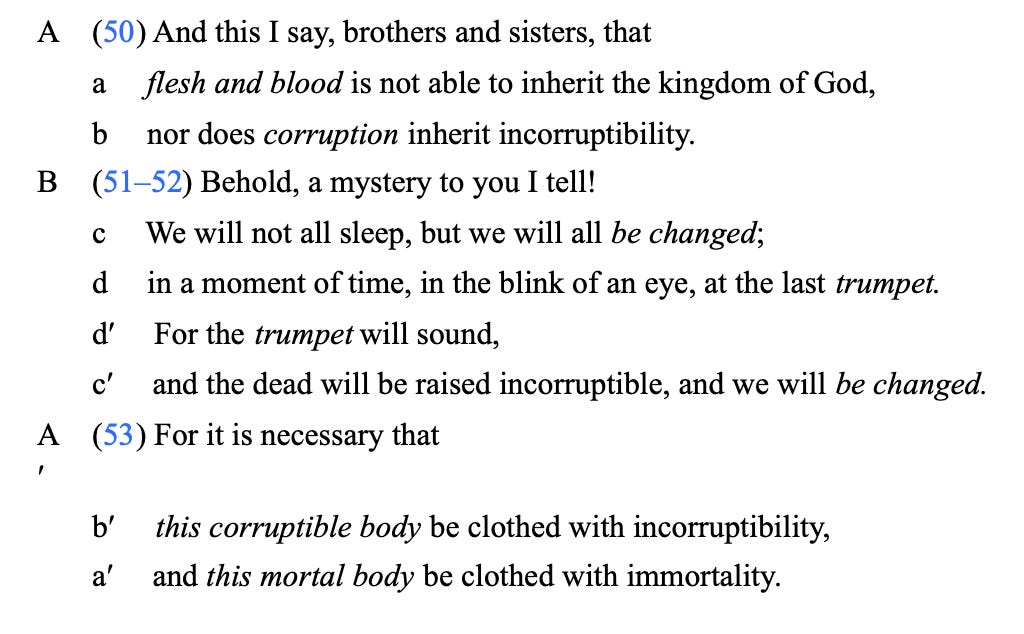
Within this larger structure, Ware draws attention to the tighter internal chiasm linking verses 50 and 53 directly:
(50)
A - flesh and blood is not able to inherit the kingdom of God
B - nor does corruption inherit incorruptibility
(53)
B’ - this corruptible body must be clothed with incorruptibility
A’ - and this mortal body be clothed with immortality
In verse 50, “flesh and blood” corresponds to “this mortal body” (τὸ θνητὸν τοῦτο) in verse 53. The plight of verse 50 receives its solution in verse 53, and the solution is not the annihilation of the body. It is that this mortal body, the same body, is clothed with immortality. The demonstrative pronoun “this” in verse 53 is emphatic: not a different body, not a replacement body, but this one, transformed.
Ware states the implication: “In the flow of Paul’s argument in vv. 50-53, ‘flesh and blood’ does not express a plus (physical embodiment) that requires a subtraction (the sloughing off of the body), but a minus (the mortality of embodied humanity) that requires an addition (the divine gift of incorruptibility and immortality).”
The problem is having a mortal body. The solution is giving that body immortality. Resurrection is addition, not subtraction.
Step Four: Verse 50 Must Be Read with Verse 39
Ware makes a further observation that most commentators miss entirely. The word σάρξ (“flesh”) appears in 1 Corinthians 15 in only two places: verse 39 and verse 50. These are the only two occurrences of the flesh-word in the entire chapter, and Ware argues they are mutually interpretive.
In verse 39, Paul writes: “Not all flesh is the same flesh, but there is one flesh for human beings, another for animals, another for birds, and another for fish.” The argument is that the Creator’s power to fashion radically different kinds of flesh for different creatures demonstrates his power to fashion a new, glorified kind of flesh for the resurrection body. Verse 39 is not saying flesh is abolished in the resurrection. It is saying flesh is transformed, just as the Creator gives each creature the flesh appropriate to its mode of existence.
Verse 50, the only other σάρξ reference in the chapter, must be read in this light. When Paul says “flesh and blood cannot inherit the kingdom,” he is picking up the thread of verse 39 and making explicit what was there implied: the present, corruptible flesh is inadequate, and transformation is necessary. Both verses affirm the glorification of the flesh. Verse 39 emphasizes the Creator’s power to accomplish this; verse 50 emphasizes its necessity.
In light of verse 39, Ware concludes, verse 50 “does not express the necessity of the flesh’s destruction but rather the necessity of its transformation to incorruptibility in the resurrection.”
Step Five: “Inheritance” and the Fullness of Adoption
Ware adds one more layer that gives the theology of verse 50 its full depth and it concerns the verb “inherit” (κληρονομέω). In Paul’s usage, inheritance is always tied to adoption as God’s children. The children of God are the heirs of the kingdom (Romans 8:17; Galatians 4:7). And Paul says explicitly in Romans 8:23 that the full adoption includes “the redemption of our body.”
To inherit the kingdom, then, is to receive the fullness of adoption, which includes bodily glorification. The risen body conformed to the image of the Son of God (Romans 8:29; Philippians 3:21) is not a body-free soul but a glorified, immortal, physical body. “Flesh and blood,” with its connotation of mortal humanity in its distance from God, is thus the precise opposite of this full adoption. To say “flesh and blood cannot inherit the kingdom” is to say: mortal, unglorified humanity, as it currently stands, cannot enter the consummated kingdom. Something must happen. That something is bodily resurrection and glorification.
Ware also observes that the “flesh and blood” idiom was regularly used in antiquity to contrast mortal humans with the immortal angels. This connects directly to Jesus’s own teaching about resurrection in Luke 20:34-36, where those who rise “are equal to the angels” and “cannot die any longer.” The resurrection does not make believers less physical. It elevates them, in their bodies, to an angelic mode of immortal existence. This is the transformation Paul announces in verses 51-53.
The Payoff
Ware closes his discussion of verse 50 with a summary that is worth dwelling on at length. The common scholarly misreading of this verse, he argues, turns Paul into a Platonist, someone who views the physical body as an impediment to be discarded. But that is not Paul’s Jewish understanding of the person as a composite of soul and body, and it is not what Paul says.
What Paul actually says is that the impediment to everlasting life is not the body’s physicality but the body’s perishability. The Son of God’s incarnation, death, and resurrection introduced something entirely new: the divine and imperishable life of God available to the physical body itself. The necessity Paul asserts in verse 50 is “the full gift of the Son’s incorruptible divine life, given to the physical body in the resurrection.”
In Ware’s words: “First Corinthians 15:50 is not about the present body’s destruction but instead its transformation, enhancement, and glorification. In the resurrection, the humanity of those united to Christ will be granted to share in the Son of God’s divine nature, not only in the soul but also in the body. It will be the consummation of union with Christ.”
The kingdom is not a kingdom without flesh. It is a kingdom where flesh has been liberated from its bondage to decay and death and brought to share, at last, in the radiant and imperishable life of God himself.
Ware’s argument is a model of what careful exegesis looks like. He does not simply assert a preferred interpretation. He establishes it from the ground up: from the ancient usage of the Greek idiom, from the contrast between “flesh and blood” and “flesh and bones” in Jewish literature, from the internal chiastic structure of the passage, from the mutual relationship between verses 39 and 50, and from the theological logic of inheritance and adoption.
The result is a reading that is both exegetically precise and theologically rich. And it is, not coincidentally, the reading that the Gospel accounts require. When the risen Christ says “a spirit does not have flesh and bones as you see that I have” (Luke 24:39), he is not contradicting Paul. The resurrection body is not less physical than the earthly body. It is the same body, transformed: freed from corruption, clothed with immortality, and brought at last into the fullness of life in the presence of God.
That is the hope Paul sets before his readers. That is what 1 Corinthians 15:50 is actually about.