

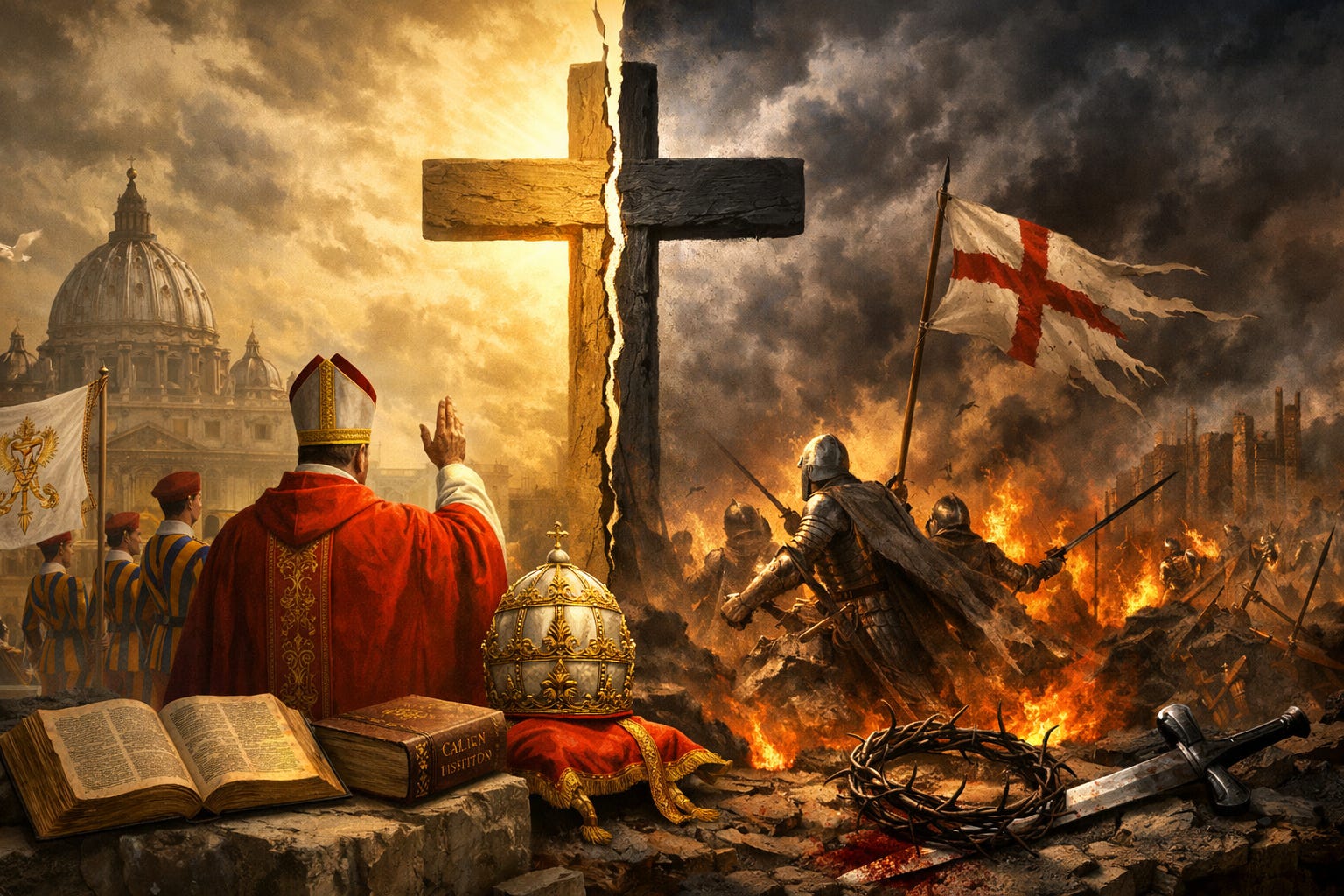
On Palm Sunday, March 29, 2026, Pope Leo XIV delivered a homily from St. Peter’s Square that presented Jesus Christ almost exclusively as a pacifist King whose God “always rejects violence,” who “does not listen to the prayers of those who wage war,” and whose cross stands as a universal moral summons to lay down arms. The homily concluded with a prayer entrusted not to God, but to Mary.
It is a moving piece of rhetoric. It is also, at nearly every major point, a departure from the full counsel of Scripture and the theology confessed by the Reformed church.
“King of Peace” - A Selective Christology
Leo XIV builds his entire homily on the repeated refrain of Christ as “King of Peace.” He rides a donkey, not a horse. He rebukes the sword. He does not defend himself. He is silent before his accusers. All of this is true, and the texts he cites (Zechariah 9:9-10, Matthew 26:52, Isaiah 53:7) are accurately quoted.
But it is precisely what the Pope omits that reveals the theological problem.
The same Christ who rode into Jerusalem on a donkey is the Christ who made a whip of cords and drove the money-changers from the temple (John 2:15). The same Christ who told Peter to put away his sword told his disciples earlier to buy one (Luke 22:36). The same Jesus who was silent before Pilate pronounced devastating curses upon the Pharisees (Matthew 23) and declared, “Do not think that I have come to bring peace to the earth. I have not come to bring peace, but a sword” (Matthew 10:34, ESV).
And the Christ of Revelation returns not on a donkey but on a white horse, with a sharp sword proceeding from his mouth, “and in righteousness he judges and makes war” (Revelation 19:11, ESV). His robe is “dipped in blood” (Revelation 19:13). He treads “the winepress of the fury of the wrath of God the Almighty” (Revelation 19:15).
To present Christ only as the King of Peace, without the King of Wrath and Judgment, is not faithful preaching. It is selective Christology. It gives the world a Christ shaped by modern sensibilities rather than by the full testimony of Scripture.
The Westminster Confession affirms that Christ executes the office of a King by “subduing us to himself, in ruling and defending us, and in restraining and conquering all his and our enemies” (WLC 45). That conquest is not merely spiritual. The Confession does not reduce Christ’s kingship to meekness. It includes judgment, conquest, and the exercise of sovereign power over all enemies.
“God Always Rejects Violence” - A Claim the Bible Cannot Support
Perhaps the most striking line in the homily is this: “He revealed the gentle face of God, who always rejects violence.”
Always?
The God of Scripture commanded the destruction of the Canaanites (Deuteronomy 7:1-2; 20:16-17). He drowned the armies of Egypt in the Red Sea and Moses sang about it (Exodus 15:1-4). He rained fire and sulfur on Sodom and Gomorrah (Genesis 19:24). He sent the angel of death through Egypt and killed the firstborn of every household without the blood of the lamb (Exodus 12:29). He struck Uzzah dead for touching the ark (2 Samuel 6:7). He sent bears to maul forty-two youths who mocked Elisha (2 Kings 2:23-24). He commanded Saul to destroy the Amalekites, man, woman, child, and animal, and rejected Saul as king for his failure to carry it out completely (1 Samuel 15).
And the psalmist did not reject violence when he wrote under divine inspiration: “Blessed shall he be who takes your little ones and dashes them against the rock!” (Psalm 137:9, ESV).
To say that God “always rejects violence” is not merely an overstatement. It is a direct contradiction of the biblical record. It requires the wholesale suppression of the Old Testament’s testimony about the character and actions of God. The God of Abraham, Isaac, and Jacob is a God of mercy and a God of war (Exodus 15:3). He is gracious and terrible. He saves and He destroys.
The Westminster Confession confesses that God’s works of providence include “his most holy, wise, and powerful preserving and governing all his creatures, and all their actions” (WCF 5.1). That government includes judgment. That judgment includes violence. The God of the Confession is not the sanitized deity of the papal homily.
Isaiah 1:15 - A Text Ripped from Its Context
The Pope declares that God “does not listen to the prayers of those who wage war, but rejects them, saying: ‘Even though you make many prayers, I will not listen: your hands are full of blood’ (Is 1:15).”
This is a serious misapplication. Isaiah 1:15 is not a blanket condemnation of all who wage war. The context of Isaiah 1 is a prophetic indictment of Israel for hypocritical worship combined with injustice. God rejects their prayers not because they are warriors, but because they are unjust oppressors who trample His courts while crushing the poor, the widow, and the fatherless (Isaiah 1:16-17, 23).
The very same God who spoke those words through Isaiah also commanded Israel to wage war, repeatedly, throughout the conquest and beyond. Joshua was commanded to take Jericho by force (Joshua 6). David was called a man after God’s own heart (1 Samuel 13:14; Acts 13:22) and was simultaneously one of the greatest warriors in Israel’s history. God gave David victory in battle after battle (2 Samuel 8:6, 14). The Psalms of David are filled with thanksgiving for military victory granted by God (Psalm 18:34, 37-42; Psalm 144:1).
If Isaiah 1:15 means what the Pope says it means, that God never hears the prayers of those who wage war, then God did not hear the prayers of Joshua, David, Jehoshaphat, or Hezekiah. That is absurd on its face.
Consider Jehoshaphat. In 2 Chronicles 20, a vast coalition of Moabites, Ammonites, and Meunites marched against Judah. Jehoshaphat was afraid. He did not lay down his weapons and appeal to the brotherhood of man. He set his face to seek the LORD and proclaimed a fast throughout all Judah. He stood in the assembly of the people at the temple and prayed: “We do not know what to do, but our eyes are on you” (2 Chronicles 20:12, ESV). This was a king at war, praying in the context of military conflict, with armies bearing down on his nation. And God’s response? He did not rebuke Jehoshaphat for waging war. He did not refuse to hear him because his hands were stained with the business of national defense. He answered through the prophet Jahaziel: “Do not be afraid and do not be dismayed at this great horde, for the battle is not yours but God’s” (20:15). Then God Himself set ambushes against the invading armies and they destroyed one another (20:22-23). God not only heard the prayer of a king at war. He answered it by performing the violence Himself.
Or consider Hezekiah. In 2 Kings 19, Sennacherib king of Assyria invaded Judah, besieged its fortified cities, and sent the Rabshakeh to Jerusalem to demand surrender and mock the God of Israel. Hezekiah did not lay down his arms. He went up to the house of the LORD, spread Sennacherib’s threatening letter before God, and prayed: “O LORD the God of Israel, enthroned above the cherubim, you are the God, you alone, of all the kingdoms of the earth... Save us, please, from his hand, that all the kingdoms of the earth may know that you, O LORD, are God alone” (2 Kings 19:15, 19, ESV). God heard that prayer. He answered through Isaiah: “I will defend this city to save it, for my own sake and for the sake of my servant David” (19:34). That night the angel of the LORD went out and struck down 185,000 Assyrian soldiers (19:35). God’s answer to the prayer of a king at war was not silence. It was not rebuke. It was the single deadliest act of divine military violence in the Old Testament.
If the Pope is right that God “does not listen to the prayers of those who wage war,” then these texts do not exist. But they do.
The Reformed hermeneutic insists on reading texts in their canonical and covenantal context, not isolating them for rhetorical convenience. The Pope has taken a prophetic rebuke of injustice and turned it into a proof text for pacifism. The text will not bear that weight.
The Cross as Moral Example vs. Penal Substitution
Throughout the homily, Leo XIV presents Christ’s suffering primarily as a moral example. Jesus “did not arm himself, or defend himself, or fight any war.” He “allowed himself to be nailed to the cross, embracing every cross borne in every time and place throughout human history.” The implication is clear: Christ’s passion is fundamentally about modeling nonviolent love for us to imitate.
This is the moral influence theory dressed in liturgical garments. It is not the gospel.
The Reformed confessional understanding of the cross is that Christ died as a substitute under the wrath of God to satisfy divine justice. “The Lord Jesus, by his perfect obedience, and sacrifice of himself, which he through the eternal Spirit once offered up unto God, hath fully satisfied the justice of his Father” (WCF 8.5). “Christ, by his obedience and death, did fully discharge the debt of all those that are thus justified, and did make a proper, real, and full satisfaction to his Father’s justice in their behalf” (WCF 11.3).
Christ did not go to the cross primarily to show us how to be nonviolent. He went to the cross to bear the violent wrath of God against sin on behalf of His elect. The cross is not a model of pacifism. It is the locus of the most terrible act of divine violence in all of history: the wrath of the Father poured out on the Son (Isaiah 53:10, “Yet it was the will of the LORD to crush him”). If God “always rejects violence,” then the cross itself becomes incoherent, because the cross is divine violence, holy, righteous, substitutionary violence against sin.
To flatten the atonement into a moral example is to gut it of its saving power. Paul did not preach Christ crucified as a peace demonstration. He preached it as the wisdom and power of God (1 Corinthians 1:23-24).
The Civil Magistrate, Just War, and Rome’s Own Theology
The theological pacifism of the homily is not merely exegetically unsound. It is confessionally rejected by the Reformed tradition.
The Westminster Confession explicitly affirms the legitimacy of just war: “It is lawful for Christians to accept and execute the office of a magistrate, when called thereunto: in the managing whereof, as they ought especially to maintain piety, justice, and peace, according to the wholesome laws of each commonwealth; so, for that end, they may lawfully, now under the New Testament, wage war, upon just and necessary occasions” (WCF 23.2).
This is not a grudging concession. It is a principled theological affirmation rooted in Romans 13:1-4, where the civil magistrate is described as God’s servant who “does not bear the sword in vain” and is “an avenger who carries out God’s wrath on the wrongdoer” (ESV). The sword of the magistrate is not a contradiction of God’s character. It is an expression of it, an expression of God’s justice executed through human government.
But here is the deeper irony: the Pope does not merely contradict the Reformed confession. He contradicts his own. The Catechism of the Catholic Church explicitly affirms the legitimacy of just war. Paragraph 2308 states: “All citizens and all governments are obliged to work for the avoidance of war. However, as long as the danger of war persists and there is no international authority with the necessary competence and power, governments cannot be denied the right of lawful self-defense, once all peace efforts have failed.” Paragraph 2309 goes on to enumerate the traditional conditions for legitimate defense by military force, conditions rooted in Rome’s own theological tradition stretching back through Thomas Aquinas and Augustine.
When Leo XIV declares from the steps of St. Peter’s that God “does not listen to the prayers of those who wage war” and commands the nations to “lay down your weapons,” he is not merely offering pastoral counsel toward peace. He is functionally repudiating a just war tradition that his own church developed, codified, and still officially teaches. Augustine formulated the foundational principles. Aquinas refined them in the Summa Theologiae (II-II, Q. 40).1 The Catechism enshrines them. And the Pope, in the name of prophetic urgency, simply sets them aside.
The Reformed position does not glorify war. It grieves over the brokenness that makes war necessary. But it refuses to deny what Scripture plainly teaches: that in a fallen world, the sword of the magistrate is ordained by God for the restraint of evil and the defense of the innocent. And it notes, with no small interest, that Rome’s own theological tradition agrees, even if this Pope does not.
Entrusting Prayer to Mary - A Violation of the Second Commandment
The homily concludes by invoking Bishop Tonino Bello, a “Servant of God” in the Roman process of canonization, and directing a prayer to Mary: “Holy Mary, woman of the third day, grant us the certainty that, in spite of all, death will no longer hold sway over us...”
From a Reformed confessional standpoint, this is a straightforward violation of the second commandment as exposited in the Westminster Standards.
The Westminster Confession teaches that “prayer, with thanksgiving, being one special part of religious worship, is by God required of all men: and, that it may be accepted, it is to be made in the name of the Son, by the help of his Spirit, according to his will” (WCF 21.3). Prayer is to be made to God alone: Father, Son, and Holy Spirit. Not to Mary. Not to saints. Not to any creature.
The Westminster Larger Catechism identifies among the sins forbidden by the second commandment: “all praying ... to saints, angels, or any other creatures” (WLC 105). There is no ambiguity here. To direct prayer to Mary, to ask Mary to “grant us” anything, is to give to a creature what belongs to God alone. It does not matter how beautifully the prayer is worded or how sincere the devotion behind it. The issue is not tone. The issue is address. Prayer is worship, and worship belongs to God.
Mary was blessed among women. She bore the incarnate Son of God. She is honored in Scripture. But she is not a mediator, she is not omniscient, she does not hear prayer, and she does not grant petitions. “For there is one God, and there is one mediator between God and men, the man Christ Jesus” (1 Timothy 2:5, ESV).
Conclusion
Leo XIV’s Palm Sunday homily is, in many ways, representative of a broader tendency in Roman Catholic public theology: the reduction of the Christian faith to a message of peace, social concern, and humanitarian compassion, underwritten by selective exegesis. It is a theology that keeps what is comfortable in Scripture and quietly sets aside what is not, including, remarkably, Rome’s own doctrinal tradition on just war.
The Reformed faith cannot follow. It confesses the whole counsel of God, a God who is merciful and just, who saves and judges, who commands peace and wages war, whose Son rode a donkey and will return on a war horse. It confesses a cross that is not merely an example of love but the satisfaction of divine justice. It confesses prayer directed to the Triune God alone. And it confesses a magistrate who bears the sword not in defiance of God but in service to Him.
The gentle Jesus of papal rhetoric is half a Christ. And half a Christ saves no one.
In Summa Theologiae II-II, Q. 40, Art. 1, Aquinas addresses the question of whether war is always sinful. After presenting four objections rooted in Scripture and natural virtue (including Christ’s command to “not resist evil” and the warning that “all that take the sword shall perish with the sword”), Aquinas answers that war is not inherently sinful provided three conditions are met: (1) it must be waged on the authority of a sovereign, not a private individual, since the care of the common weal belongs to those in authority who bear the sword as God’s ministers (Romans 13:4); (2) it must have a just cause, namely that those attacked deserve it on account of some fault; and (3) the belligerents must have a rightful intention, aiming at the advancement of good or the avoidance of evil rather than cruelty, vengeance, or the lust for power. Aquinas draws heavily on Augustine throughout, citing his argument that if Christianity forbade war altogether, the soldiers in the Gospel would have been told to cast aside their arms rather than to “be content with your pay” (Luke 3:14).
Excellent Jason!