

Gary DeMar’s latest podcast, “Hope and the Glorious Inheritance,” features Kim Burgess in what is billed as the final installment of their series on 1 Corinthians 15. Two moments in this episode deserve a close look. Not because they’re surprising. Because they expose the same fault lines that have marked full preterism since I walked away from it fifteen years ago. I’ll let Gary and Kim speak for themselves, add my thoughts, and let you draw your own conclusions.
Part One: Gary Finally Says What I’ve Been Saying for Fifteen Years
Read this carefully:
Kim: I mean, when you deal with eschatology, you’re really ultimately dealing with everything because it all comes together in that whole eschatological concept. Eschatology is not just the last chapter in the systematic theology. It’s not just the last questions and answers in the catechism. That’s not the way to understand it.
Gary: And I think that’s something a lot of people don’t understand. “OK, now that we’ve looked at everything else, now we’re going to look at eschatology.” And you can’t do that. Eschatology is woven throughout the entire New Testament, and you just can’t pull out individual passages and then combine those individual passages and come up with an eschatological belief system. You have to see everything within the context of which Jesus talked about and what the apostles talked about. And it’s an integrated whole with having to understand the parts at the same time as you’re dealing with the whole.
I agree with every word of that. It is also long past time Gary said it.
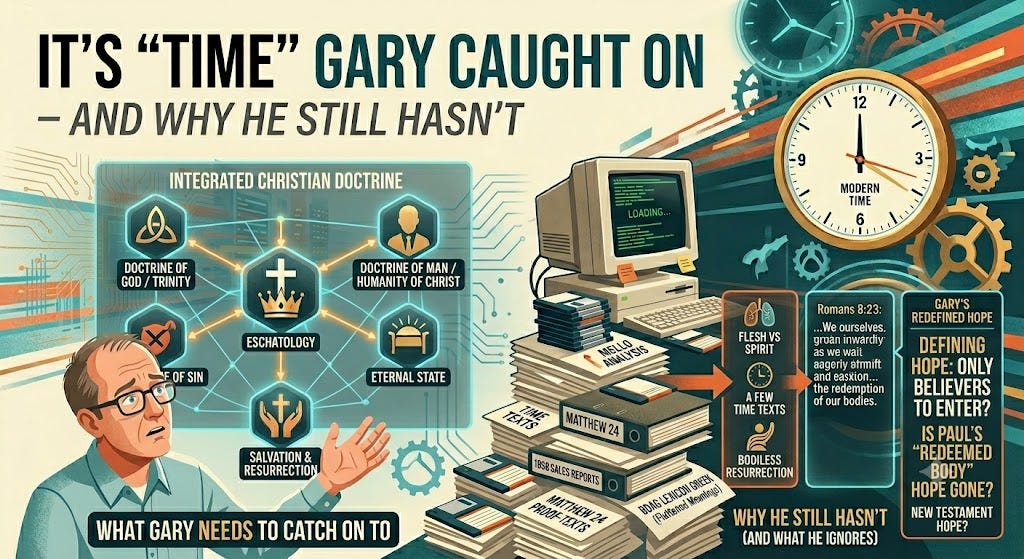
I have been making this exact argument since I renounced full preterism around 2010. Eschatology is not a self-contained department you can manage in isolation from the rest of Christian doctrine. It reaches into your doctrine of God, your doctrine of man, your understanding of sin, the nature of salvation, the resurrection, the church, the sacraments, and the eternal state. Get eschatology wrong, on the essentials, and the damage does not stay inside the “last things” chapter. It spreads.
Which is why Gary’s agreement here is so remarkable. And so self-indicting.
He has spent decades doing precisely what he accuses others of doing. His entire system is built on what he calls "time texts," a handful of passages where words like mello ("about to"), "this generation," and similar phrases appear. From those texts he draws the conclusion that everything must be fulfilled. Then, when you ask what that means for everything else, the nature of the resurrection body, the eternal state, the continuing humanity of Christ, the ongoing intercession of the Son, the coherence of the Trinity, Gary goes quiet. He changes the subject. Or, as happened in our exchange over mello, he bows out of the conversation entirely when the exegetical pressure builds.
On mello specifically: Gary has treated this word as a near-universal imminence marker. Wherever it appears, he argues it forces an “about to” meaning that demands first-century fulfillment. The Greek lexical evidence does not support that. BDAG, the standard reference lexicon for New Testament Greek, gives mello a range of meanings that extend well beyond temporal imminence. To flatten every occurrence into “about to happen” is a classic case of what James Barr called the illegitimate totality transfer: reading one contextually specific meaning back into every instance of the word regardless of what the syntax and context actually require. When I pressed that point, the conversation ended. Gary was not willing to follow the evidence where it led.
And then there is the breathtaking scope of what Gary simply ignores. He insists that “it is all fulfilled” but has never seriously worked out what that claim costs every other Christian doctrine. Take one example from 1 Corinthians 15. Paul writes:
When all things are subjected to him, then the Son himself will also be subjected to him who put all things in subjection under him, that God may be all in all. (1 Cor. 15:28)
Who is “the Son” in this passage? According to full preterism, Gary included, Christ has divested himself of his human nature. The incarnation, in their view, was a temporary covenantal arrangement suited to the old-covenant-to-new-covenant transition, and it is now behind us. What remains is the divine Son. Not the God-Man.
Now ask the question Gary will not ask. What does it mean for the divine Son to “subject himself” to the Father? What are the Trinitarian implications of that? Does it introduce subordinationism into the eternal relations of the Godhead? Does it redefine the Son’s relation to the Father in ways the Nicene and Chalcedonian Fathers would have flagged as dangerous? Gary has not addressed this. Not once. He has discussed time texts and Matthew 24 for years without ever sitting down to trace what his conclusions require of the doctrine of God.
So yes, Gary. Eschatology does affect everything else. But you are the last person who should be congratulating yourself for noticing it, because you have refused to follow that insight to its necessary conclusions. A fulfilled eschatology that evacuates the resurrection of bodily content, strips Christ of his humanity, and redefines the hope of the saints has consequences running through every article of the faith. Gary deals with none of them.
If anyone has taken a handful of proof texts and built an entire system out of them, it is Gary DeMar. The full preterist hermeneutic has produced an interpretive grid that reduces to something like this: flesh is bad and belongs to the old covenant; Spirit is good and belongs to the new covenant. The warrant for that entire grid? A few time texts. An argument about mello. And Gary’s reading of Matthew 24.
That is exactly the kind of atomistic, proof-text-driven eschatology he is criticizing. He just does not recognize himself in the description.
Part Two: The Word Game They Play With “Hope”
Later in the same episode:
Kim: So we’ll get to the time question at the end, but already we’ve got hints of what to expect.
Gary: Yeah, I think this is important to, that what you’re going, when I’m listening to this, and I’m trying to visualize or conceptualize how the typical Christian would understand all of this, and without the timing element involved, they would see almost all of this as something that is yet to take place definitively, and that they’re—
Kim: Well for them it was yet to take place. The question is, how far in the future is this?
Gary: Right, yeah, but they would see this thing, oh, this is something, we’re in this parenthesis right now. All of this stuff that’s here, we’re in this parenthetical time period, which the realization of all of this, the fulfillment of all this is yet to take place. We have to wait for some end time eschatological event to take place, and then this was all gonna take place when we get, we reign on the earth with Jesus for 1,000 years.
Kim: Yep, well that’s a critical issue. I think the timing issue really comes down. The when question is the most critical question of all. In other words, if you’re talking about already and not yet, we pretty much all agree on it already. Where the confrontation comes in is, well, how do we date the timing of the not yet? And I’m fully on the side of the fact with the preterists that yes, this not yet expectation, at least in objective, covenantal, historical, or even historical sense, was something to expect in their generation. Otherwise these verses make absolutely no sense.
Gary: Yeah, an AV supporter today sent me a email by Tom, about a new commentary on Revelation, by Tom Shriner, I think his name is. In fact, I met him some time ago. He’s a pretty, pretty real solid guy. He’s written this commentary on Revelation, and he gets to the time verses in Revelation chapter one. And it’s typical, he acknowledges, yes, it seems like these things were about to take place. I mean, that’s what those words mean. There are lots of people who claim that John was mistaken, he misinterpreted, and then he tries to get around what those words mean. And this is that phrase that R.C. Sproul used in that book. And he wrote the forward to And It Came to Pass about saving the phenomena. That is, you have a particular prophetic system that you have to maintain, and you will do almost anything to skirt around what seems to be obvious at first reading.
Kim: It’s a futile effort, I think. Exegetically, it’s just it cannot be refuted in terms of what we’re talking about. That is the mean that I’m a hyper-preterist either. The hope still continues for us today. There are people who are still coming to Christ, and a hope of entering into the kingdom of God. But the point is, there’s gotta be a kingdom of God already in place for them to enter into it.
Gary: Right.
Two things.
First: the label game. Kim and Gary are full preterists. The transcript makes that plain. They argue that the “not yet” expectation of the New Testament was fulfilled in the first century. That is the defining claim of full preterism. But in the same breath, Kim insists he is not a “hyper preterist.” What exactly is the distinction?
The two terms are synonyms. "Hyper preterist" was coined by Reformed theologians to describe those who deny the bodily return of Christ, the general resurrection, and the general judgment by placing all of it in the first century. That is exactly what Gary and Kim teach. Full preterists did not like the label, so they manufactured a distinction, reserving "hyper" for an even more radical fringe that denies the ongoing relevance of the Gospel altogether, and positioning themselves as something more moderate by comparison. It was a rhetorical move, not a theological one. Gary has either forgotten this history or is banking on the fact that his audience has. If the entire "not yet" expectation of the apostles was fulfilled in the first century, you are a full preterist. You are a hyper preterist. The label you prefer changes nothing.
Second: what they have done to hope. This is where the real damage surfaces. Kim says “the hope still continues for us today,” but notice what that hope now consists of. He defines it as a hope for people who are still coming to Christ, a hope of entering into the kingdom. Once you are in, apparently, the hope no longer belongs to you.
Take that back to Romans 8 and read it honestly. Paul is not writing to unbelievers hoping to get into the kingdom. He is writing as a regenerate man, an apostle, someone who has already received the firstfruits of the Spirit. What is he hoping for? “We ourselves, who have the firstfruits of the Spirit, groan inwardly as we wait eagerly for adoption as sons, the redemption of our bodies” (Rom. 8:23). The hope Paul is straining toward is bodily redemption, the resurrection of the dead, something not yet received, not yet realized, but genuinely expected. He is not writing as someone who has not yet entered the kingdom. He has entered. He has the Spirit. He is still waiting for more.
What Gary and Kim have done is move that hope outside of us. They have turned it into an evangelistic entry category, a hope belonging to the not-yet-converted, and stripped it of its eschatological content for those who already believe. That is not the already/not-yet framework orthodox Reformed theology has always confessed. In the classic schema, believers are genuinely already in the kingdom and genuinely still awaiting its consummation, including the resurrection of the body, the renewal of creation, and the final judgment. All of that remains ahead of us.
Gary and Kim agree on the first half. They erased the second.
That is the pattern throughout their work. They borrow the vocabulary, "already/not yet," "hope," "inheritance," "resurrection," "glory," and quietly redefine each term until it carries content the New Testament writers would not recognize. Then they want you to believe the only thing separating them from orthodox Christianity is a disagreement about timing.
It is not a timing disagreement. It is a disagreement about what happened, what remains, and what we are still waiting for. It touches the resurrection. It touches the nature of Christ. It touches the hope of every believer who has ever groaned under the weight of a body still subject to decay. It touches the Trinity.
Yes, Gary. Your eschatology affects everything else. You said so yourself.
Now do the work.