

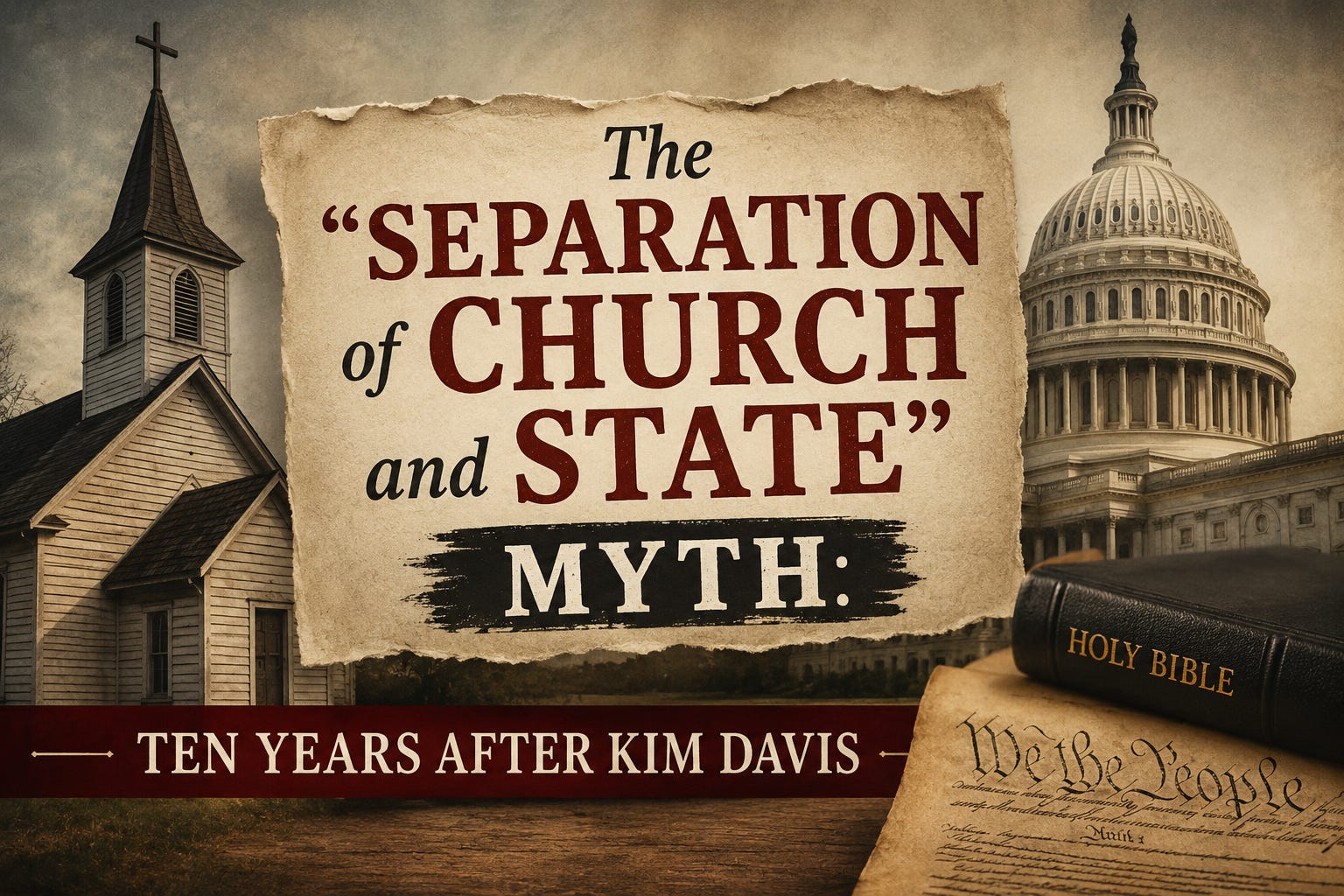
Ten years ago, a county clerk in Rowan County, Kentucky became the most hated woman in America for a few weeks. Kim Davis refused to issue marriage licenses to same-sex couples in the wake of Obergefell v. Hodges because of her religious conviction that marriage is between one man and one woman. She explained herself plainly at the time:
I never imagined a day like this would come, where I would be asked to violate a central teaching of Scripture and of Jesus Himself regarding marriage. To issue a marriage license which conflicts with God’s definition of marriage, with my name affixed to the certificate, would violate my conscience.1
As a side note, this definition of marriage also happened to be Kentucky law, written into the state constitution by 74 percent of Kentucky voters in 2004:
Only a marriage between one man and one woman shall be valid or recognized as a marriage in Kentucky. A legal status identical or substantially similar to that of marriage for unmarried individuals shall not be valid or recognized.
That provision is still on the books.2 Five unelected lawyers in Washington declared it void, but the people of Kentucky never repealed it.
What happened to Kim Davis
Since I first wrote about this in 2015, the story has run its full course, and the ending is instructive. Davis was held in contempt by a federal judge and jailed for six days in September 2015 for refusing to put her name on the licenses. While she sat in jail, the couple who sued her, David Ermold and David Moore, obtained their license from a deputy. In 2016 Kentucky changed its law so that marriage licenses no longer bear the county clerk’s name at all, which was the accommodation Davis had asked for from the beginning. Had that simple concession been offered in the summer of 2015, no one would ever have heard her name.
The concession came too late to save her. She lost reelection in 2018. The civil suit against her ground on for a decade. In 2023 a jury awarded Ermold and Moore $100,000 in emotional damages, and the court later added roughly $260,000 in attorneys’ fees, all assessed against Davis personally. The Sixth Circuit affirmed in 2025. Her attorneys at Liberty Counsel then filed a petition asking the Supreme Court not only to review the damages award but to overturn Obergefell itself, arguing that the decision rested on the same substantive due process fiction the Court repudiated in Dobbs. It was the first formal request since 2015 asking the Court to revisit the ruling.
On November 10, 2025, the Court denied the petition without comment. Not one justice noted a dissent, not even Thomas or Alito, who had dissented in Obergefell and who wrote pointedly in 2020 that the decision continues to threaten the religious liberty of Americans like Davis. Add to this the Respect for Marriage Act of 2022, which passed Congress with the votes of dozens of Republicans and requires every state to recognize same-sex marriages performed anywhere in the country, and the picture is clear. The political and legal establishment, including much of its conservative wing, has made its peace with Obergefell.
So the woman who appealed to her conscience paid with her office, six days in a cell, and a third of a million dollars. And the question I raised in 2015 remains exactly where I left it, because the loudest argument thrown at her then is the same one thrown at every Christian in public office now: “separation of Church and State.”
What the First Amendment actually says
When I ask people what they mean by “separation of Church and State,” they argue, typically, that those who rule are to keep their religious beliefs to themselves; religious thinking should not influence their governing. And when I ask where this so-called law comes from, they almost always cite the First Amendment of the U.S. Constitution. Does the First Amendment support the idea that civil magistrates cannot rule according to religious beliefs?
In short: No. Not even close.
Congress shall make no law respecting an establishment of religion, or prohibiting the free exercise thereof;...3
Allow me to let constitutional scholar and historian Dr. Brion McClanahan explain the meaning of this portion of the First Amendment:
The First Amendment is arguably the most famous and most debated amendment in the Bill of Rights. Madison combined five civil liberties into the First in order to condense the various proposals from the State Ratifying Conventions. There are several important components to the First Amendment, not the least of which is the first five words, “Congress shall make no law....” This established a precedent for the next nine amendments and amplified the preamble to the Bill of Rights. They were designed to limit the powers of the general government only. States were exempt and could, if the several legislatures wished, pass laws establishing a church, limiting the press, outlawing seditious speech or restricting the right of assemblage. Madison attempted to incorporate portions of the Bill of Rights into the State constitutions, for example prohibiting the establishment of State churches, but this was rejected. As with the other amendments in the Bill of Rights, the intent of the First is easy to ascertain and only made cloudy by silver-tongued lawyers and judges bent on political gain.
The first liberty protected by the First Amendment, “freedom of religion,” has received the most attention. What did the Founders mean by the “establishment of religion”? The Virginia and North Carolina proposals made clear their definition. “No particular religious sect or society ought to be favored or established, by law in preference to others.” In other words, the Congress would not be able to legally establish a “religious sect or society,” that is a specific Christian denomination, as the “Church of the United States” in the manner of the established Church of England. But this did not by any means imply that the Founders intended public life to be devoid of religion.
Amos Singletary said in the Massachusetts Ratifying Convention that he was troubled that “there was no provision that men in power should have any religion: and though he hoped to see Christians, yet by the Constitution, a Papist, or an Infidel was as eligible as they...in this instance we were giving great power to we know not whom.” Thomas Lusk lamented in the same convention that “Roman Catholics, Papists, and Pagans might be introduced into office and that Popery and the Inquisition may be established in America.” Isaac Backus, a leading proponent of freedom of conscience in colonial America, answered that because the Constitution forbade religious tests (Article VI, Clause 3), “Popery or some other tyrannical way of worship...” could not be established by the Congress. Daniel Shute, however, provided the clearest explanation of the word “religion.” “Far from limiting my charity and confidence to men of my own denomination in religion, I suppose, and I believe, sir, that there are worthy characters among men of every denomination, among Quakers, the Baptists, the Church of England, the Papists; and even among those who have no other guide, in the way of virtue and heaven than the dictates of natural religion.”
Virginia and North Carolina were the two States that proposed an amendment guaranteeing religious freedom, so their views might deserve special weight. In North Carolina, Henry Abbot equated “religion” with denomination. “I believe the majority of the community are Presbyterians. I am, for my part, against any exclusive establishment; but if there were any, I would prefer the Episcopal.” North Carolina’s governor Samuel Johnston defined “religion” the same way and commented that the “religions” of the States included members of the Presbyterian, Baptist, and Episcopalian churches, as well as Quakers and other “sects.” Some members of the Convention used the word “religion” in its broader sense. But there was unanimity that morality and religion were bed rocks of a stable society.
Madison made the most revealing statement in regard to the intent of the “establishment clause” during debate over the amendment in 1789. He proposed that the word “national” be inserted before “religion.” This would, he hoped, “satisfy the minds of honorable gentlemen. He believed that the people feared one sect might obtain a preeminence, or two combine together, and establish a religion to which they would compel others to conform. He thought if the word national was introduced, it would point the amendment directly to the object it was intended to prevent.” For Madison, the purpose was to prevent the establishment of a national “Church of the United States.” In no way was it to inhibit the constitutionally protected “free exercise” of religion. And again, the First Amendment applied only to the general government. States had free rein on this issue, and most had either an established church or a strict religious test for office holders.4
That last sentence deserves to be read twice. At the time the First Amendment was ratified, most of the states had either an established church or a strict religious test for office holders, and nobody at the time thought the First Amendment touched them. That fact alone should silence the “separation of Church and State” chant once and for all. One simply cannot reconcile the modern mantra with the state constitutions themselves. Here is a sample.
The State Constitutions
1776 Constitution of Pennsylvania5
SECT. 10. A quorum of the house of representatives shall consist of two-thirds of the whole number of members elected; and having met and chosen their speaker, shall each of them before they proceed to business take and subscribe, as well the oath or affirmation of fidelity and allegiance hereinafter directed, as the following oath or affirmation, viz:
I do swear (or affirm) that as a member of this assembly, I will not propose or assent to any bill, vote, or resolution, which shall appear to me injurious to the people; nor do or consent to any act or thing whatever, that shall have a tendency to lessen or abridge their rights and privileges, as declared in the constitution of this State; but will in all things conduct myself as a faithful honest representative and guardian of the people, according to the best of my judgment and abilities.
And each member, before he takes his seat, shall make and subscribe the following declaration, viz:
I do believe in one God, the creator and governor of the universe, the rewarder of the good and the punisher of the wicked. And I do acknowledge the Scriptures of the Old and New Testament to be given by Divine inspiration.
1776 Constitution of Delaware6
ART. 22. Every person who shall be chosen a member of either house, or appointed to any office or place of trust, before taking his seat, or entering upon the execution of his office, shall take the following oath, or affirmation, if conscientiously scrupulous of taking an oath, to wit:
“I, A B. will bear true allegiance to the Delaware State, submit to its constitution and laws, and do no act wittingly whereby the freedom thereof may be prejudiced.”
And also make and subscribe the following declaration, to wit:
“I, A B. do profess faith in God the Father, and in Jesus Christ His only Son, and in the Holy Ghost, one God, blessed for evermore; and I do acknowledge the holy scriptures of the Old and New Testament to be given by divine inspiration.”
1777 Constitution of Vermont7
And each member, before he takes his seat, shall make and subscribe the following declaration, viz.
“I ____ do believe in one God, the Creator and Governor of the Universe, the rewarder of the good and punisher of the wicked. And I do acknowledge the scriptures of the old and new testament to be given by divine inspiration, and own and profess the protestant religion.”
1776 Constitution of North Carolina8
XXXII. That no person, who shall deny the being of God or the truth of the Protestant religion, or the divine authority either of the Old or New Testaments, or who shall hold religious principles incompatible with the freedom and safety of the State, shall be capable of holding any office or place of trust or profit in the civil department within this State.
1778 Constitution of South Carolina9
XXXVIII. That all persons and religious societies who acknowledge that there is one God, and a future State of rewards and punishments, and that God is publicly to be worshipped, shall be freely tolerated. The Christian Protestant religion shall be deemed, and is hereby constituted and declared to be, the established religion of this State. That all denominations of Christian Protestants in this State, demeaning themselves peaceably and faithfully, shall enjoy equal religious and civil privileges. To accomplish this desirable purpose without injury to the religious property of those societies of Christians which are by law already incorporated for the purpose of religious worship, and to put it fully into the power of every other society of Christian Protestants, either already formed or hereafter to be formed, to obtain the like incorporation, it is hereby constituted, appointed, and declared that the respective societies of the Church of England that are already formed in this State for the purpose of religious worship shall still continue incorporate and hold the religious property now in their possession. And that whenever fifteen or more male persons, not under twenty-one years of age, professing the Christian Protestant religion, and agreeing to unite themselves in a society for the purposes of religious worship, they shall, (on complying with the terms hereinafter mentioned,) be, and be constituted a church, and be esteemed and regarded in law as of the established religion of the State, and on a petition to the legislature shall be entitled to be incorporated and to enjoy equal privileges. That every society of Christians so formed shall give themselves a name or denomination by which they shall be called and known in law, and all that associate with them for the purposes of worship shall be esteemed as belonging to the society so called. But that previous to the establishment and incorporation of the respective societies of every denomination as aforesaid, and in order to entitle them thereto, each society so petitioning shall have agreed to and subscribed in a book the following five articles, without which no agreement or union of men upon pretence of religion shall entitle them to be incorporated and esteemed as a church of the established religion of this State:
1st. That there is one eternal God, and a future State of rewards and punishments.
2d. That God is publicly to be worshipped.
3d. That the Christian religion is the true religion.
4th. That the holy scriptures of the Old and New Testaments are of divine inspiration, and are the rule of faith and practice.
5th. That it is lawful and the duty of every man being thereunto called by those that govern, to bear witness to the truth.
This is not old news
Ten years after I first compiled this list, these provisions are still sitting in the constitutions of eight states. Six of them contain outright religious tests, and two more explicitly protect religious officeholders provided they acknowledge a Supreme Being.
Arkansas10
Article 19, section 1: No person who denies the being of a God shall hold any office in the civil departments of this State, nor be competent to testify as a witness in any Court.
Maryland11
Article 37: That no religious test ought ever to be required as a qualification for any office of profit or trust in this State, other than a declaration of belief in the existence of God; nor shall the Legislature prescribe any other oath of office than the oath prescribed by this Constitution.
Mississippi12
Article 14, section 265: No person who denies the existence of a Supreme Being shall hold any office in this State.
North Carolina13
Article VI, section 8: The following persons shall be disqualified for office: First, any person who shall deny the being of Almighty God.
South Carolina14
Article XVII, section 4: No person who denies the existence of a Supreme Being shall hold any office under this Constitution.
Tennessee15
Article IX, section 2: No person who denies the being of God, or a future State of rewards and punishment, shall hold any office in the civil department of this State.
And the two that allow for religion in office without requiring it:
Pennsylvania16
Article 1, section 4: No person who acknowledges the being of a God and a future State of rewards and punishments shall, on account of his religious sentiments, be disqualified to hold any office or place of trust or profit under this Commonwealth.
While this provision does not require a religious test, it clearly protects religious thought in its officers. A person is not disqualified for rejecting the “separation of Church and State” myth.
Texas17
Article 1, section 4: No religious test shall ever be required as a qualification to any office, or public trust, in this State; nor shall any one be excluded from holding office on account of his religious sentiments, provided he acknowledge the existence of a Supreme Being.
Now, in the interest of honesty, let me anticipate the objection. Since Torcaso v. Watkins in 1961, the Supreme Court has held that these state religious tests cannot be enforced, on the theory that the Fourteenth Amendment “incorporated” the First Amendment against the states. But notice what that objection concedes. It concedes that the First Amendment, as written and ratified, did no such thing. The tests were constitutional for a century and a half, and the men who wrote and ratified the First Amendment served alongside them without a murmur. It took a twentieth-century Court, wielding a doctrine invented long after the founding generation was in the grave, to declare that “no law respecting an establishment of religion” secretly meant the opposite of what everyone who wrote it understood it to mean. The people of these eight states, meanwhile, have never repealed the provisions. They remain in the text as standing witnesses against the myth, in exactly the way Kentucky’s marriage amendment remains in its text.
Nothing has changed, and everything has
No matter how loudly the online activists scream, there is no getting around the history. The blending of religious conviction and civil office has existed from the founding and is still acknowledged in the current constitutions of eight states. It never violated the U.S. Constitution because the First Amendment never granted the federal government the power to prohibit it in the first place. The Bill of Rights was insisted upon by the founding generation for the express purpose of restricting federal power. Granting the federal government authority to squelch religious conviction in state officers would have been unthinkable to the men who ratified it.
What has changed since 2015 is not the argument but the terrain. In 2015 I wrote that those screaming loudest about Kim Davis “breaking the law” were the ones ignoring state law, twisting the intent of the First Amendment, and applauding the arrest of a county clerk by a federal government that had overstepped its constitutional bounds. Ten years on, that federal overreach has been ratified by nearly everyone. The Court that overturned Roe would not even hear a challenge to Obergefell. Congress codified the redefinition of marriage with bipartisan votes. Davis herself was stripped of her office and made personally liable for a third of a million dollars for the crime of believing what every state in the union believed until roughly fifteen years ago, and what the church of Jesus Christ has confessed for two thousand years: “Marriage is to be between one man and one woman” (Westminster Confession of Faith 24.1). Our Lord Himself grounded it in creation: “Have you not read that he who created them from the beginning made them male and female, and said, ‘Therefore a man shall leave his father and his mother and hold fast to his wife, and the two shall become one flesh’?” (Matt. 19:4-5, ESV).
The lesson of the Davis affair is not that the historical argument failed. It has never been answered; it has only been ignored. The lesson is that appeals to the original Constitution will not save us, because the courts long ago substituted their own authority for its text. The magistrate is God’s servant whether he confesses it or not (Rom. 13:4), and a nation that penalizes its officers for acknowledging the Governor of the universe, while its own founding charters required exactly that acknowledgment, has not achieved neutrality. It has simply established a different religion, one with its own creeds, its own tests for office, and its own heretics. Kim Davis was the first of them. She will not be the last.
https://www.lpm.org/news/2015-09-01/update-rowan-county-clerk-says-refusal-to-issue-marriage-licenses-a-matter-of-religious-liberty
https://apps.legislature.ky.gov/Law/Constitution/Constitution/ViewConstitution?rsn=268
https://www.archives.gov/founding-docs/bill-of-rights-transcript
https://www.google.com/books/edition/The_Founding_Fathers_Guide_to_the_Consti/S5K1AwAAQBAJ?hl=en&gbpv=1&dq=%22The+First+Amendment+is+arguably+the+most+famous%22&pg=PA182&printsec=frontcover
https://avalon.law.yale.edu/18th_century/pa08.asp
http://avalon.law.yale.edu/18th_century/de02.asp
http://avalon.law.yale.edu/18th_century/vt01.asp
http://avalon.law.yale.edu/18th_century/nc07.asp
http://avalon.law.yale.edu/18th_century/sc02.asp
https://50constitutions.org/ar/constitution/section-id-61556
https://50constitutions.org/md/constitution/section-id-74360
https://50constitutions.org/ms/constitution/section-id-73150
https://50constitutions.org/nc/constitution/section-id-137815
https://50constitutions.org/sc/constitution/section-id-91832
https://50constitutions.org/tn/constitution/section-id-87234
https://50constitutions.org/pa/constitution/section-id-129506
https://50constitutions.org/tx/constitution/section-id-58088
Great article Jason!
You may want to consider the story of Ann Widdlecombre, the last old school British battleaxe. https://unherd.com/2026/07/ann-widdecombe-britains-last-battleaxe/
It will take a lot of educated, disciplined, committed American Christians to retake the terrain you mentioned.
In truth, they need not be a lot, but they need to be determined... and they need to represent someone other than just God and themselves.
If they only represent God and themselves, and are not solidly backed by the Body of Christ in general?
Well, those committed believers will be held in honour by God, but the nation as a whole will be lost.
“Son of man, when a land sins against me by acting faithlessly, and I stretch out my hand against it and break its supply of bread and send famine upon it, and cut off from it man and beast, even if these three men, Noah, Daniel, and Job, were in it, they would deliver but their own lives by their righteousness, declares the Lord God." — Ezekiel 14:13-15, ESV