


Full preterists (aka hyper-preterists) have a problem. A rather embarrassing one. Many of the most learned, careful, and exegetically serious Reformed scholars who have engaged the preterist question in detail have landed in the same place: not full preterism. And they have given their reasons.
But the full preterist cannot accept this. He cannot accept that an intelligent, Bible-believing scholar could examine the same evidence and arrive at a different conclusion. So he has developed a single, all-purpose explanation for every case of theological disagreement: the other guy is afraid.
He is afraid of losing his job. He is a slave to church tradition. He is hemmed in by his “theological friends.” He doesn’t have the courage to “cross the line.” He knows full preterism is true, but the cost is too high. The pattern is so consistent, so predictable, and so intellectually lazy that it deserves to be named for what it is: a nutty conspiracy complex. And once you see it, you see it everywhere.
The truth is, we should not be surprised by this. Full preterism is conspiratorial by nature. It has to be. The entire church, across every tradition, for two thousand years, has rejected this teaching. Every major creed, confession, and catechism affirms a future bodily return of Christ, a future bodily resurrection of the dead, and a future final judgment. If you are going to claim that all of these bodies, all of these theologians, and all of these centuries got it wrong, you need an explanation for why. And the explanation full preterists have settled on is not that the church made an honest exegetical error. It is that the truth has been suppressed.
You see this in their treatment of the Greek word mello, which they claim Bible translators have conspired to hide or mistranslate in order to obscure the preterist meaning of key New Testament texts. You see it in their claim that seminary instructors, Bible college faculty, publishers, and pastors are all “afraid to form a proper test question” on full preterism for their students, because they know that if they do, they will get fired. You see it in their constant refrain that partial preterists are “inconsistent” and secretly know they should be full preterists but lack the courage to say so. Conspiracy is not an unfortunate byproduct of full preterism. It is baked into its DNA. A system that requires two millennia of universal Christian witness to be wrong cannot survive without a theory of suppression. So we should hardly be surprised when its advocates treat individual critics the same way they treat the entire church: as people who know the truth and refuse to say it.
Kim Burgess on R.C. Sproul: “Church Tradition Was Holding Him Back”
Gary DeMar’s coauthor and self-styled eschatology guru, Kim Burgess, recently wrote the following about R.C. Sproul:
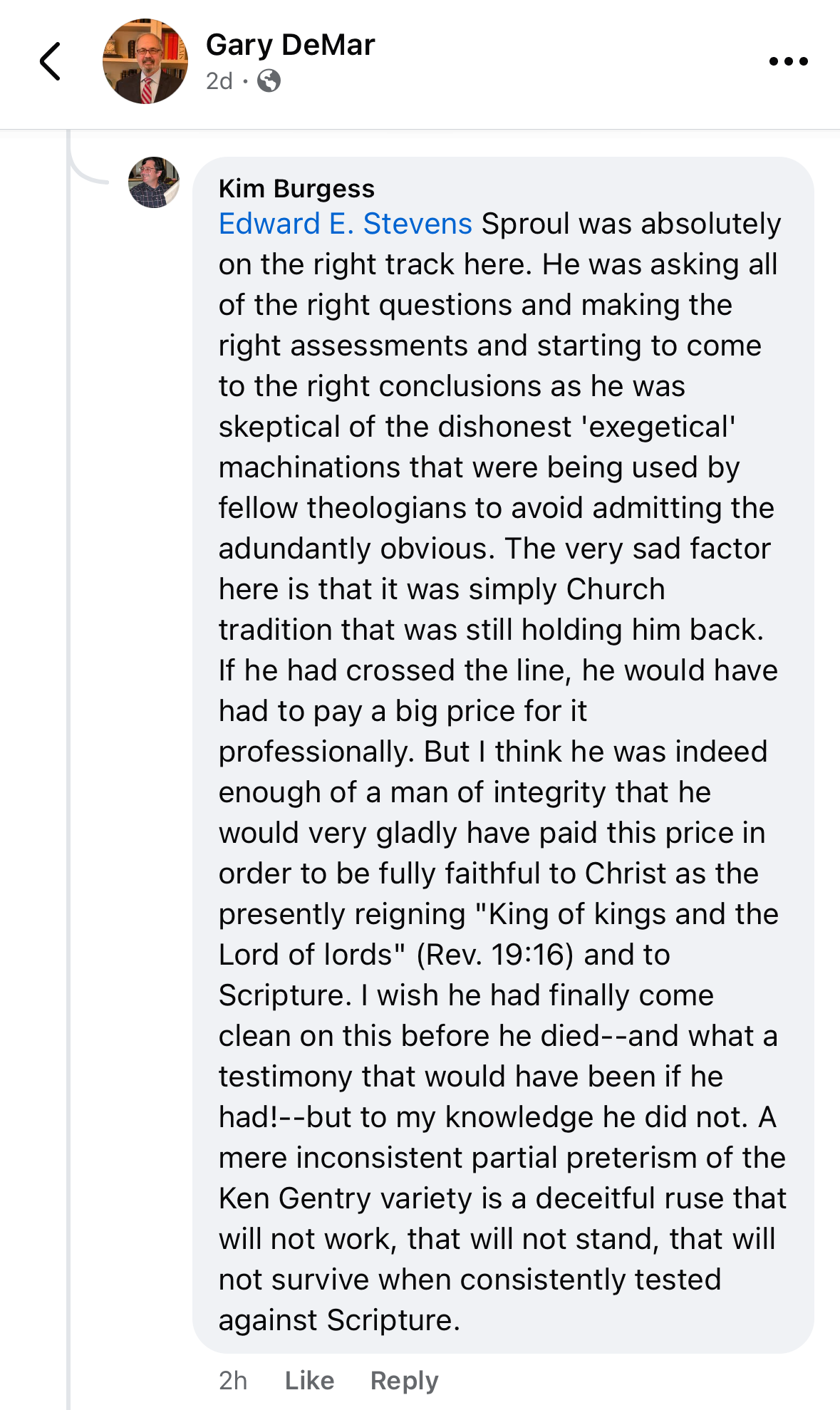
This is the conspiracy complex in its purest form. A dead man who left a detailed written record of his reasoning is posthumously psychoanalyzed and told that his real problem was not exegetical but psychological. Sproul did not disagree with Burgess because of the text of Scripture. He disagreed because “Church tradition” was “holding him back.”
There is just one problem: Sproul told us exactly why he rejected full preterism, and it had nothing to do with tradition, fear, or professional pressure.
In The Last Days According to Jesus (Baker Books, 1998), Sproul explicitly defined his position as “moderate preterism” and stated that the purpose of the book was to evaluate and defend it. He identified the resurrection as the chief dividing line between the two camps and then explained his hermeneutical reasoning for refusing to cross it. On Paul’s description of the rapture in 1 Thessalonians 4, Sproul dismantled the full preterist approach:
If this is the case, why did the apostle use the language he did? He said the Lord would descend with a shout, but Russell says nobody could hear it. The voice of the archangel is silent, and the trumpet of God is mute. Not only this, but the multitude of the rising dead were caught up invisibly into invisible clouds to meet the invisible, coming Lord.1
Sproul’s point was hermeneutical. The Olivet Discourse employs apocalyptic imagery with abundant Old Testament precedent, and a figurative reading is legitimate. Paul’s language in 1 Thessalonians 4 is didactic prose. The genre demands a different treatment. Whether you find Sproul's reasoning convincing is irrelevant. What is relevant is that he had a reason, he gave it in writing, and it had nothing to do with church tradition or professional self-preservation.
Then, in a 2014 Ligonier “Ask R.C. Live” event, Sproul was asked directly: “You hold to what’s called a partial preterist view, is that correct?” He replied: “Yes. Not a full Preterist view. The Full Preterism teaches that all of the New Testament prophecies regarding the future kingdom and the future coming of Christ were all fulfilled in the first century. I don’t believe that. I still think there’s much more to happen.” He added: “We’re still looking forward to the return of Jesus. And He hasn’t come yet.”
That was three years before Sproul died. There is no ambiguity. There is no hidden sympathy. There is a man who gave his answer, explained his reasoning, and never retracted it. Burgess’s narrative requires us to believe that Sproul was lying in his own book, on camera, and for the entire final two decades of his ministry. That is not an argument. That is a conspiracy theory.
Gary DeMar on Kenneth Gentry: “Burned at the Stake by the Protestant Popes”
Burgess is not alone in this pattern. Gary DeMar has deployed the same tactic against Kenneth Gentry, one of the most prolific partial preterist scholars alive.
In a May 2025 article titled “Why Ken Gentry Must Oppose Full Preterism” on the American Vision website, DeMar accuses Gentry of changing his earlier positions on the Greek word mello and on Matthew 24:27 for one reason: self-preservation. DeMar writes:
“He was flying too close to the full preterist sun, so he lowered his altitude so he would not be burned at the stake by the Protestant Popes and lose his publishing market.”
And again:
“He needs to maintain some distance from full preterism.”
And once more:
“There is too high of a price to pay for engaging with full preterist arguments because his ‘theological friends’ would attack him without mercy.”
Notice what DeMar does not do in this article. He does not demonstrate from Scripture that Gentry’s revised positions are exegetically wrong. He does not engage the hermeneutical arguments. Instead, he attributes Gentry’s conclusions to fear of professional consequences. According to DeMar, Gentry does not believe what he says he believes. He is performing orthodoxy to keep his friends and his market. The accusation is not that Gentry is wrong, but that Gentry is insincere.
This is the same move Burgess makes with Sproul. Different target, identical logic: “He knows the truth, but he is afraid to say it.”
In a follow-up piece titled “Heresy Hunting as a Theological Blood Sport” (October 2025), DeMar expands the conspiracy framework further. He frames the entire debate as a campaign of suppression by people who throw around the word “heresy” to avoid engaging the arguments. The problem, according to DeMar, is never that full preterism is wrong. The problem is always that its critics are suppressing it for ulterior motives.
Jeremy Hasty on Me: “Creedal Selections” and “Employment”
I have experienced this pattern firsthand. In a recent Facebook exchange, a full preterist named Jeremy Hasty asked me what verses I would cite to support the physical bodily return of Christ at the end of history. I directed him to three articles on my blog:
1. “A Man Will Rule the World: Psalm 8 and the Continuing Incarnation of Christ”
2. “What Does ‘Return’ Even Mean?”
3. “A Man Will Judge the World”
Hasty claimed to have read all three. His verdict? I “lean heavily on the creedal selections.”
Here is the reality. Across those three articles, approximately twenty-two Scripture passages are cited: Acts 1:9-11, Acts 3, John 14:2-3, John 16:7, Matthew 28:20, Colossians 3:1, Hebrews 2:5-17, Hebrews 9, 1 Corinthians 15:26-28, Ephesians 1, Matthew 21:16, Genesis 1:26-28, James 3:7-8, Daniel 7, 1 Timothy 2:5, John 5, Acts 17:31, Psalm 8:1-9, Job 19:25-26, and more. The one and only creedal reference in all three articles was the Heidelberg Catechism Q&A 46-48, used illustratively to show that the Reformed standards affirm what the Bible teaches. One catechism question. In three articles. And somehow I am “leaning heavily on creeds.”
But it did not stop there. Instead of addressing the actual arguments, Hasty pivoted to motivations. He insinuated that I hold to partial preterism to keep my employment.
I renounced hyper-preterism in 2010 while driving a semi-truck, and have maintained that full preterism is refuted by Scripture every year since, driving locally in Tennessee and Florida, and ultimately until 2022 when I became self-employed by inheriting Whitefield Seminary. The accusation is not only wrong, it is absurd.
Then came the debate claim. Hasty travelled around multiple Facebook pages telling people I was afraid to debate a full preterist. When I asked him to name one person who had challenged me to a debate and been declined, he could not produce a single name. Not one. The accusation was invented out of thin air.
But it gets better. Hasty apparently took it upon himself to contact Don Preston and Michael Sullivan to arrange a debate with me. And they declined. Their stated reason? My “bad behavior.”
Stop and consider the absurdity of this. Full preterists spend their days accusing partial preterists of being greedy, dishonest, cowardly, and enslaved to tradition. They psychoanalyze dead men. They tell living scholars that their published positions are lies. They accuse seminary professors of running a cover-up. But when someone calls out their arguments in plain language, suddenly he is guilty of “bad behavior” and they will not engage him.
Hasty’s accusation backfired completely. He set out to prove that I was the one running from debate. What he proved instead is that they are. Gary DeMar himself attempted to engage me on the question of mello, until the conversation cornered him. I was prepared to continue. He was the one who quit.
And yet I was not surprised, because this is the same thing they said about Sproul. It is the same thing they said about Gentry. It is the same thing they will say about anyone who looks at the evidence and concludes that full preterism is wrong.
The Pattern
Let me lay this out plainly, because the pattern is so uniform it could be a template:
A partial preterist presents exegetical arguments for why he rejects full preterism.
The full preterist ignores the exegetical arguments because, he insists, the time texts (which control everything) are being ignored - and besides, [NAME] disagrees with you, so there.
The full preterist attributes the partial preterist’s conclusion to fear, tradition, professional self-interest, or some combination of the three.
The full preterist portrays himself as the courageous truth-teller and his opponent as a coward, a sell-out, or a prisoner of man-made creeds.
Sproul? Held back by “Church tradition.” Afraid to “pay a big price.” Gentry? “Burned at the stake by the Protestant Popes.” Protecting his “publishing market.” Bradfield? “Leaning on creeds.” Keeping his “employment.” Afraid to debate. Except when a “debate” was actually occurring, the full preterist was the one who ran.
It is always the same. The explanation is never “he examined the text and reached a different conclusion.” It is always “he knows we are right but is too afraid to admit it.” It is a conversation-ender posing as an argument.
Why This Matters
This matters because it functions as a substitute for exegesis. If you can dismiss every critic as a coward or a tradesman, you never have to answer their arguments. You never have to explain how the general resurrection of the dead can be “fulfilled” as a purely spiritual, invisible, imperceptible non-event in which only some participated. You never have to explain how Paul’s description of the Lord descending with a shout, the voice of an archangel, and the trumpet of God can be waved away as “accommodative language.” You never have to explain how the “blessed hope” of the church for two thousand years was a misunderstanding. You just have to say: “He knows. He’s afraid.”
It reminds me of flat earthers who spent years complaining that NASA’s photos of the earth were too grainy and low-resolution to be trusted. When the Artemis II crew sent back stunning high-resolution images of a spherical earth from over 100,000 miles out, the goalposts moved. The problem was no longer the resolution. It was something else entirely. It is always something else entirely. You cannot satisfy a conspiracy nut with evidence, because the conspiracy is not a conclusion drawn from the evidence. It is a prior commitment that the evidence is made to serve. Full preterism works the same way. The arguments are never really engaged. The scholars are never really answered. There is always another reason why the other guy does not count.
This is also deeply disrespectful to the men being accused. Sproul left a career in the mainline church over the authority of Scripture. Gentry has spent decades doing the kind of painstaking exegetical work that most of his accusers could not replicate in a lifetime. And I was driving a truck when I came to the convictions I hold now. I lost some full preterist friends. None of us arrived at partial preterism because it was the safe, comfortable, professionally advantageous option. We arrived here because the text of Scripture led us here.
Engage the arguments or concede the point. But stop hiding behind conspiracy theories. Stop slandering people. Stop lying. The full preterist who cannot conceive of an honest disagreement has not refuted his opponent. He has only revealed that he has no answer.
R. C. Sproul, The Last Days according to Jesus, electronic ed. (Grand Rapids: Baker Books, 2000), chap. 7.