

Paul wrote 1 Thessalonians to a young church he had been forced to leave. Luke records that he reasoned in the synagogue at Thessalonica on three Sabbaths, and that opposition later drove him out of the city (Acts 17:1-10). He taught the new believers to “wait for his Son from heaven” (1 Thess. 1:10),1 and he left them facing persecution (2:14; 3:3-4). Unable to return, he sent Timothy, who came back with good news of their faith and love (3:6). But between Paul’s departure and this letter, some members of the church had died. The letter itself shows what troubled the survivors. They were waiting for Christ to return, and they feared that those who died before He came would miss His coming or be at a disadvantage when it happened (4:15). So Paul writes, “But we do not want you to be uninformed, brothers, about those who are asleep, that you may not grieve as others do who have no hope” (4:13), and he ends, “Therefore encourage one another with these words” (4:18). That is why ministers still read these verses at burials.
Kim Burgess and Gary DeMar devote chapter 9 of The Resurrection of the Dead: The Mortal Swallowed Up by Life (“Caught Up with the Lord”) to this passage. In that chapter DeMar twice asks Burgess the obvious question: who are “the dead” in 1 Thessalonians 4? Burgess gives two different answers, seventeen pages apart, and then admits, “Wires can surely start to get crossed here.”2
What the Book Says
The question gives Burgess trouble because of what he believes happens at death. He holds that Christ’s death and resurrection opened heaven, so that from then on a Christian who dies goes straight to the Lord and receives his resurrection body at once. “At the moment of physical death they would have a body that is made fit for the eternal and imperishable/incorruptible Kingdom of God” (18). Again: “immediately upon this event of physical death, we will have an eternal and glorious existence ... that will be a newly-embodied existence and life with God in the heavens” (181). He means resurrection in the full sense: “Those saints who have died and have been resurrected (yes, resurrected!) are ‘sons of God, being sons of the resurrection’” (192). Old Testament saints were different. They waited in Sheol, and “their resurrection was to occur at the parousia of Christ in AD 70” (231).
He then places 1 Thessalonians 4 in AD 70: “It was then that ALL of the saints ... would be, and were, brought, per the historically-objective, covenantal accomplishment of redemption, into the eternal Kingdom of God.... This is the subject matter of 1 Thessalonians 4” (81). He does not take the catching up physically: “for the living, it is not to be a case of them being bodily jerked up and removed from point A to point B” (215). The saints are “raised up ... Spiritually, not physically, not geographically” to reign in the heavenly places (227), and meeting the Lord is “but a fancy metaphor for full covenantal reconciliation with God” (221).
With that in view, here is DeMar’s question the first time he asks it:
GARY: Let’s make this clear. The “dead ones” here are who exactly?
KIM: If I look at it from the perspective of Paul’s subject matter in 1 Corinthians 15, I think “the dead” there is a specific reference to the Old Covenant saints who had lived and died long before Christ’s coming, but clearly here in 1 Thessalonians 4, it is not limited to them, but includes the loved ones of the Thessalonians saints who had also died somewhat recently. (213)
Sixteen pages later DeMar asks again, this time about Christians who died after Christ’s resurrection and ascension:
GARY: The question I have now relates to “the dead.” What happened to the Christians who died after the death, resurrection, and ascension of Christ? “We shall not precede those who have fallen asleep.” Paul is talking about those first-century Thessalonians. If they did not precede those who had fallen asleep, when did those who did fall asleep? When did this transition occur for them between Jesus’ death and the destruction of Jerusalem in AD 70? (229)
Burgess points to Stephen, 2 Corinthians 5:8, Philippians 1:21-23 and Hebrews 10:19-20 to show that these Christians went straight to the Lord. Then he concludes:
It was only the deceased Old Covenant saints that were waiting, and they were the ones that the yet-living saints on Earth were not to precede. Paul says nothing here about the saints who died after AD 30 and went directly to be with the Lord. I believe Paul is making this distinction in 1 Corinthians 15 between (1) those he refers to as the “dead ones/dead persons” (15:12-17: the Old Covenant dead) and (2) those he speaks of, like Stephen, as having “fallen asleep” in Christ (15:6, 18, 20), though I hate to press this distinction too far, for it does not always hold (cf. Acts 13:36 with regard to King David). (230)
Put simply, Burgess now says that when Paul wrote, the Thessalonians’ own dead already had their resurrection bodies in heaven. So Paul’s promise that the living “will not precede those who have fallen asleep” cannot be about them. It has to be about Abraham, David and the prophets, who were still waiting in Sheol. Burgess sees the difficulty right away:
Wires can surely start to get crossed here because it seems like the living are being said to precede the dead, but this is not the case with these deceased post-AD 30 saints like Stephen. They were no longer living at that point and so they are not bound by the restriction in 1 Thessalonians 4:17. (231)
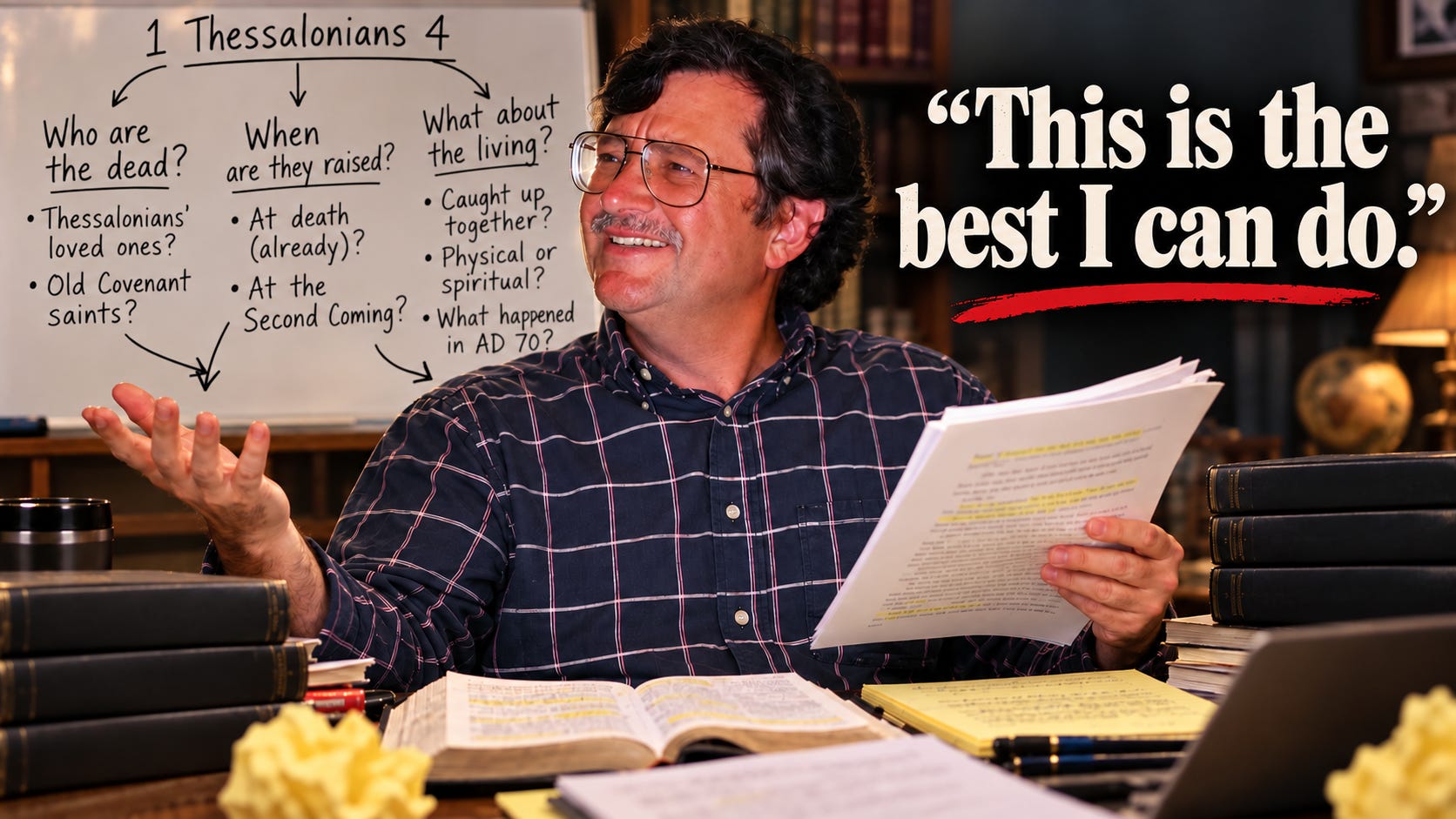
Later on the same page he ends the discussion: “This is the best I can do” (231).
Where the Book Contradicts Itself
The chapter leaves three questions unanswered, and each one comes from the order of Paul’s own argument: who the dead are, when they are raised, and what happens to the living.
The first question is who the dead are, and Paul answers it himself. He writes about “those who are asleep” (4:13). He promises that God will bring with Jesus “those who have fallen asleep” (4:14). He assures the living that they “will not precede those who have fallen asleep” (4:15). Then he says that “the dead in Christ will rise first” (4:16). Nothing in these verses signals a change of subject. The people who have fallen asleep in verses 13-15 are the dead in Christ in verse 16, and they are the Thessalonians’ own dead, the people the church was grieving.
Burgess first agreed. On page 213 he said that “the dead” in this passage are “not limited to” Old Testament saints “but includes the loved ones of the Thessalonians saints who had also died somewhat recently.” That concession matters, because the identification does not rest on the traditional reading alone. Burgess saw the same thing in the text. But on page 230 he takes it back: “Paul says nothing here about the saints who died after AD 30.” He gives no reason from the passage for the change, and nothing in verses 13-16 marks a point where the Thessalonians’ dead drop out and Old Testament saints take their place. Ironically, DeMar opened the chapter with a rule from Fee and Stuart that forbids that move: “A text cannot mean what it could never have meant for its original readers/hearers” (211). Grieving Thessalonians could not have heard “those who are asleep” as a reference to Abraham.
Burgess’s terms do not hold either. In 1 Corinthians 15 he made “the dead” the term for Old Testament saints and “fallen asleep” the term for Christians who died after Christ came: “‘The dead’ were those OT dead.... Those who had ‘fallen asleep’ or were presently ‘falling asleep’ in Christ were/are, in contrast, those who, like the martyr Stephen, died after Christ had come” (20). In 1 Thessalonians 4 Paul uses both terms for one group within three verses, and on page 230 Burgess has to concede that his distinction “does not always hold.” He also claims that “Scripture never seems to want to speak about Christians as having ‘died’ per se” (213). His reason is that Christians cannot “die” in the sense of “perish forever” (213), and that much is true. But his claim is about Scripture’s wording, and the wording is against him. The passage in front of him speaks of “the dead in Christ” (4:16), and he himself builds repeatedly on “Blessed are the dead who die in the Lord” (Rev. 14:13; 46, 81).
The second question is when the dead are raised. Paul says that “the dead in Christ will rise” when “the Lord himself will descend from heaven” (4:16). Burgess believes that a Christian receives his resurrection body when he dies (18, 181, 192), and that 1 Thessalonians 4 was fulfilled in AD 70 (81). Once the dead in verse 16 are shown to be the Thessalonians’ own dead, Burgess has two options. He can say those believers were raised twice, once when they died and again in AD 70, which he does not believe. Or he can say that Paul changed the subject between verses 15 and 16, which the text does not allow. On page 230 Burgess takes the second option. But if he is right, Paul’s words of comfort end up saying nothing about the very people the Thessalonians were mourning.
The third question is what happens to the living. Paul says they will be “caught up together with them” (4:17), that is, together with the dead, at the Lord’s coming. Burgess agrees that Paul’s “we” means “the ones then living, the ones then remaining alive until the parousia of the Lord in their day” (112). But he adds that “they all would be ‘changed’ eventually, because this bodily or ‘image’ (15:49) change comes via the process of death” (112). On that view, no one alive in AD 70 was changed or caught up together with the dead. Each of them joined the dead later, one at a time, by dying. Burgess does say something happened to the living in AD 70: a corporate, covenantal transition in which they were “raised up ... Spiritually ... to sit with Christ in those heavenly places” (227). Yet he calls that same seating, from Ephesians 2:6, “the ‘already’ reality” (224). On his reading, then, the living received at the Lord’s coming the union with Christ they already had, not the change Paul promised.
After a full chapter on 1 Thessalonians 4, the book still cannot say who “the dead” are, when they rise, or how the living join them. It gives two answers to the first question and closes with “This is the best I can do” (231). Paul answered all three in six verses, and the church has never had trouble reading him.
What Paul Promised
Paul writes “about those who are asleep” (peri tōn koimōmenōn, 4:13). The present participle describes people in the condition of sleep, and the occasion of the letter shows who they are: members of this church who had died. His concern is their grief, “that you may not grieve as others do who have no hope.” The Thessalonians were not mourning the patriarchs. They had “turned to God from idols ... to wait for his Son from heaven” (1:9-10), and some of them had died before He came. As verse 15 suggests, their fear was that these believers would miss His coming. That fear only makes sense about their own dead.
Paul answers that fear first from the resurrection of Jesus: “For since we believe that Jesus died and rose again, even so, through Jesus, God will bring with him those who have fallen asleep” (4:14). He uses the plain word “died” (apethanen) for Jesus and keeps “sleep” for believers, and the words “even so” tie their outcome to His. Then comes the promise: God “will bring with him” (axei syn autō) those who have fallen asleep. Interpreters differ over whether Paul means that the departed come with Jesus at His descent, or that God, having raised them, brings them with Jesus into His presence (compare 2 Cor. 4:14). Either way, Paul ties their future to Jesus’ own resurrection. That they are with the Lord in the meantime is taught more plainly elsewhere, in texts Burgess himself cites: “to depart and be with Christ” (Phil. 1:23), “away from the body and at home with the Lord” (2 Cor. 5:8).
Next Paul gives the order of events: “For this we declare to you by a word from the Lord, that we who are alive, who are left until the coming of the Lord, will not precede those who have fallen asleep. For the Lord himself will descend from heaven with a cry of command, with the voice of an archangel, and with the sound of the trumpet of God. And the dead in Christ will rise first” (4:15-16). Paul uses the strongest form of negation in Greek (ou mē phthasōmen): the living will by no means go ahead of the dead. “The Lord himself” (autos ho kyrios) comes in person. And “the dead in Christ will rise” (anastēsontai), with the same verb Paul used of Jesus two verses earlier, when he said Jesus “died and rose” (anestē). What God did for the body of Jesus on the third day, He will do for theirs when Christ comes down from heaven. Their rising is future, and it is tied to the Lord’s coming, not to the day each of them died. Paul makes the same argument in 1 Corinthians 15:20-23: Christ is “the firstfruits of those who have fallen asleep,” and then “at his coming those who belong to Christ.” In both places the risen Christ is the pattern, and His coming is the occasion.
This is where Burgess’s reading breaks down. He agrees that Christians who died after the cross “went directly to be with the Lord” (230), and Paul says that these same believers “will rise” when the Lord comes (4:16). Burgess can account for only one of those statements at a time. If the Thessalonians’ dead already have their resurrection bodies, nothing is left for them to rise from. If they are not the ones who rise, the passage is about someone else. Only the church’s historic interpretation fits both: the believer’s soul is with Christ while his body sleeps, and at Christ’s coming the body is raised. It’s that simple.
Burgess’s own definition of sleep points the same way: “The language of ‘sleep’ is used, for that’s what the bodily appearance is to us of a deceased person” (213). But if sleep describes the body, then waking describes the body too. On the next page he cites Daniel 12:2: “many of those who sleep in the dust of the ground will awake” (214). What sleeps in the dust is what wakes from it.
Verse 17 describes the meeting: “Then we who are alive, who are left, will be caught up together with them in the clouds to meet the Lord in the air, and so we will always be with the Lord.” Two phrases matter most. “Together with them” (hama syn autois) puts the living and the dead in the same moment. “To meet” (eis apantēsin) was often used of people going out to meet an arriving visitor, sometimes in a city’s formal reception of a dignitary.3 Luke uses it when the brothers from Rome “came as far as the Forum of Appius and Three Taverns to meet us” (Acts 28:15). Paul pictures the whole church, the living and the raised, going out together to receive its King. He teaches the same hope elsewhere: “he who raised the Lord Jesus will raise us also with Jesus and bring us with you into his presence” (2 Cor. 4:14), and “we shall not all sleep, but we shall all be changed, in a moment” (1 Cor. 15:51-52).
Paul ends by telling the church to encourage one another “with these words” (4:18), and the words are about these dead. A promise about Abraham would not have comforted the Thessalonians about their own dead, and a metaphor for covenant standing would not have answered their question. Paul’s answer was direct: your dead are with Jesus, they will rise when He comes, and you will be with them and with Him forever. Again, it’s that simple.
At the Graveside
The Westminster Standards follow this passage closely. At death “the souls of the righteous, being then made perfect in holiness, are received into the highest heavens ... waiting for the full redemption of their bodies” (WCF 32.1).4 Their bodies “even in death continue united to Christ, and rest in their graves as in their beds, till at the last day they be again united to their souls” (LC 86). Then “at the last day, such as are found alive shall not die, but be changed: and all the dead shall be raised up, with the selfsame bodies, and none other” (WCF 32.2), and “the righteous, being caught up to Christ in the clouds, shall be set on his right hand” (LC 90). Each part of 1 Thessalonians 4:14-17 is there: the soul with Christ, the body asleep, the Lord’s descent, the rising of the dead, the change of the living, and the catching up together.
The trouble in Burgess’s chapter does not come from Paul. It comes from wrongly dating the return of Christ to AD 70, and mishandling the resurrection texts that use mellō, such as Acts 24:15, by insisting that the word has only one meaning, “about to” (see my series on mellō). Once that date is fixed, every Christian who died before it must either be risen already or be waiting somewhere Paul never mentions, and the passage has to be bent to fit. Without that assumption the passage reads plainly. The Thessalonians’ dead, the martyrs of the first century, and every Christian who has died since are in the same condition: with the Lord, waiting for the day when God brings them with Jesus and raises their bodies from the dust.
That is why a minister can read 1 Thessalonians 4 at a Christian’s burial and mean it about the person being buried. On Burgess’s reading he cannot. Either that believer has already risen, in which case “will rise” is not true of him, or the verse is about someone else. Paul wrote it about believers like the one being buried, and he told the church what to do with it:
“Therefore encourage one another with these words.”
Unless otherwise noted, Scripture quotations are from the English Standard Version (ESV). Scripture quoted within Burgess’s text keeps the NASB wording he uses.
Kim Burgess with Gary DeMar, The Resurrection of the Dead: The Mortal Swallowed Up by Life (Powder Springs, GA: American Vision, 2026), 231. Subsequent references to this work are cited parenthetically in the text.
Erik Peterson argued that the term was a technical one for such receptions in “Die Einholung des Kyrios,” Zeitschrift für systematische Theologie 7 (1930): 682-702. For the case against, see Michael R. Cosby, “Hellenistic Formal Receptions and Paul’s Use of ΑΠΑΝΤΗΣΙΣ in 1 Thessalonians 4:17,” Bulletin for Biblical Research 4 (1994): 15-33; and, in reply, Robert H. Gundry, “A Brief Note on ‘Hellenistic Formal Receptions and Paul’s Use of ΑΠΑΝΤΗΣΙΣ in 1 Thessalonians 4:17,’” Bulletin for Biblical Research 6 (1996): 39-41.
The Westminster Confession of Faith (WCF) is cited by chapter and section and the Larger Catechism (LC) by question number, from the text of 1647.