

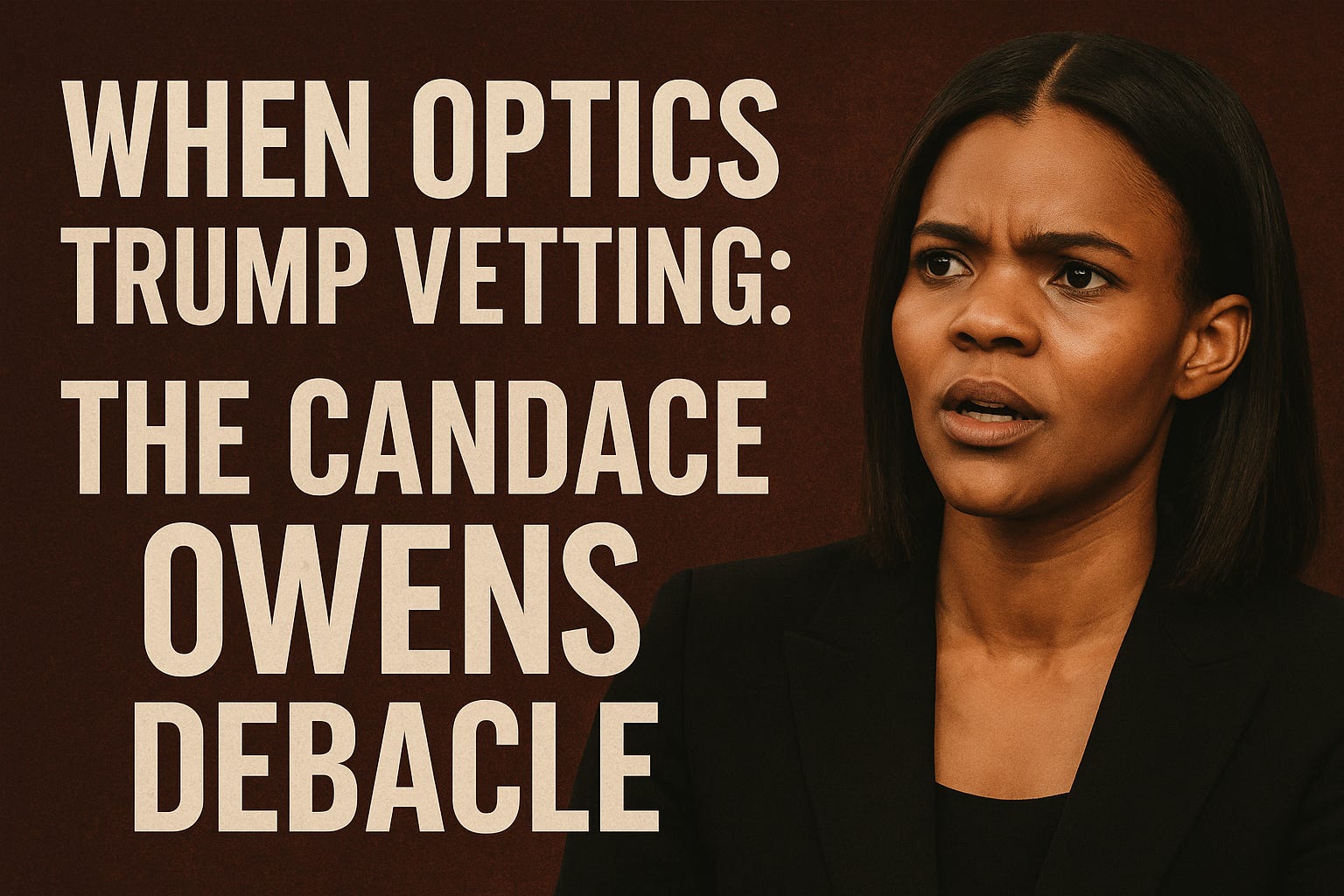
I really wish conservatives and Republicans would learn something from the Candace Owens debacle. The lesson is simple: stop elevating people overnight without watching them for a while and doing some basic vetting. Much of the early enthusiasm around Candace seemed driven by optics, the appeal of having a young Black woman suddenly speaking conservative talking points. Whatever the motivation, it never should have happened, especially if you were paying attention to what she was doing right before she supposedly became conservative literally “overnight,” in her own words.
Before her political shift, Candace was behind the Social Autopsy website. The stated goal was to fight online bullying by archiving abusive comments and, when the information was already public, exposing the people behind them. On paper, that sounds like accountability. In practice, it quickly became something far more reckless. The project proposed compiling names, screenshots, and identities into a centralized, searchable archive, which is exactly how doxxing campaigns operate, even when defenders insist the information is “public.” The Kickstarter page made clear this was not a passive archive or a vague anti-bullying effort. It was designed to catalog people and make them easy to find.
The project began to unravel once people actually examined the Kickstarter campaign itself. One of the most vocal critics was Zoe Quinn, who publicly challenged Social Autopsy after reviewing the proposal. Others quickly followed. The objection was not Candace’s stated intentions, but the foreseeable consequences of the system as it was described. As criticism mounted, Kickstarter suspended the campaign, and Social Autopsy was abandoned before it could be built. That sequence matters. The project did not quietly disappear because Candace had second thoughts. It collapsed under public pressure once people saw what it was explicitly designed to become. Only after that backlash did Candace begin reframing the project as something that never truly launched, was misunderstood, or amounted to little more than a splash page.
This is where a pattern becomes clear. While the project was being promoted, it was presented as ambitious and actionable, with concrete features and real-world aims. Once those features were scrutinized, the project was recast as minimal, exaggerated by critics, or derailed by bad-faith attacks. That same rhetorical move appears repeatedly later in Candace’s career: bold claims on the front end, followed by minimization and deflection once the implications are challenged.
After the fallout, Dave Rubin, who more or less introduced Candace to a wider audience, brought her on his show to “debate” Blaire White. I listened to the entire hour-and-a-half conversation while driving a semi because I wanted to understand why this woman was gaining traction so quickly. What stood out was not just the controversy but Blaire’s concern about Candace’s patterns. One of Blaire’s central criticisms was Candace’s habit of making serious accusations without evidence.
If you listen closely, Blaire’s objections were focused and, in hindsight, prescient. His biggest issue with Social Autopsy was not intent but what the project predictably enabled. Aggregating names, screenshots, and photos into a single database effectively created a target list. By lowering the barrier to harassment and vigilantism, the site enabled harm even if Candace was not the one carrying it out. Blaire’s point was simple: building the infrastructure that enables harm still carries responsibility.
Blaire also pressed Candace on her shifting explanations of what Social Autopsy actually was. At different points, Candace described it as a non-functioning splash page, as something that never really launched, and yet also acknowledged that it contained or could collect large amounts of data. That inconsistency alone raised red flags and made it difficult to trust her narrative.
But the clearest example comes later in the exchange about Richard Spencer and Tree of Logic. Blaire asks Candace directly whether she has evidence for her claims that Spencer was paid or acting as an operative and that Tree of Logic was funded to lie about her. Candace admits she cannot prove those claims. She reframes them as personal suspicion and argues that since others cannot disprove them either, she feels justified in saying them publicly anyway.
That is not a slip of the tongue. It is a conscious move. Candace concedes the lack of evidence, refuses to retract the claims, and reframes public accusation as acceptable speculation. This is exactly the behavior Blaire had been criticizing all along. His concern was never just Social Autopsy. It was credibility and the ethics of making serious claims without receipts.
The moment is easy to miss because the conversation is chaotic and emotionally charged. Candace pivots to tone and perceived persecution. Rubin tries to de-escalate rather than stop and examine what was just admitted. But substantively, this is the fulcrum of the entire debate. Candace openly acknowledges she cannot substantiate the accusations and insists on repeating them anyway.
To his credit, Blaire acknowledged that Candace may not have intended harm, and Candace eventually conceded that Social Autopsy was misguided and abandoned. But they never agreed on responsibility. Candace framed the criticism as envy-driven and political. Blaire framed it as principled and necessary.
Here is the key point: the instability people are seeing from Candace now is not new. It is the same pattern we saw then. The defensiveness. The escalation. The tendency to accuse first and justify later. The habit of treating suspicion as morally equivalent to evidence. None of this appeared out of nowhere. The warning signs were there early, and many ignored them because Candace was rhetorically effective and politically useful.
This episode should be a cautionary tale for conservative institutions, platforms, donors, and gatekeepers. Movements are shaped not only by ideas but by the people they choose to amplify. When influence is granted on the basis of momentum or optics rather than character, consistency, and accountability, the resulting damage is not accidental. It is self-inflicted. If conservatives want credibility and staying power, they must slow down, test voices over time, and take warning signs seriously, even when that is inconvenient. Elevation without vetting does not merely risk embarrassment. It all but ensures eventual collapse.
I agree with your assessment of Candace. However, Blaire White is a he, not a she.