

Recently, someone shared a screenshot of my latest critique of Gary DeMar on Facebook. Rather than respond to the substance of it, Gary fired back that I wouldn’t have a life without him. It’s a convenient deflection. Rather than engage the substance of criticism, just paint the critic as obsessed. It’s the kind of rhetorical move you make when you’d rather not answer the actual arguments.
But I got curious. If I’m the one who supposedly can’t function without Gary DeMar as a topic of conversation, what does Gary’s own track record look like? So I ran the numbers. I ran a script to crawl both my site and americanvision.org to count how many pages mention specific individuals by name.
Here’s what I found.
My Blog
On reformation.blog, the name “DeMar” appears on 65 pages. That’s it. Sixty-five. Out of the entirety of my blog’s content. And the reason it appears at all is because DeMar is one of the most visible proponents of a theological position that is deeply heretical and demonstrably dishonest, and because he runs within our circles while pretending to still be Reformed.
Gary’s Blog
Now let's look at americanvision.org. I searched for just four names. Four dispensationalist theologians that Gary has spent years critiquing and responding to:
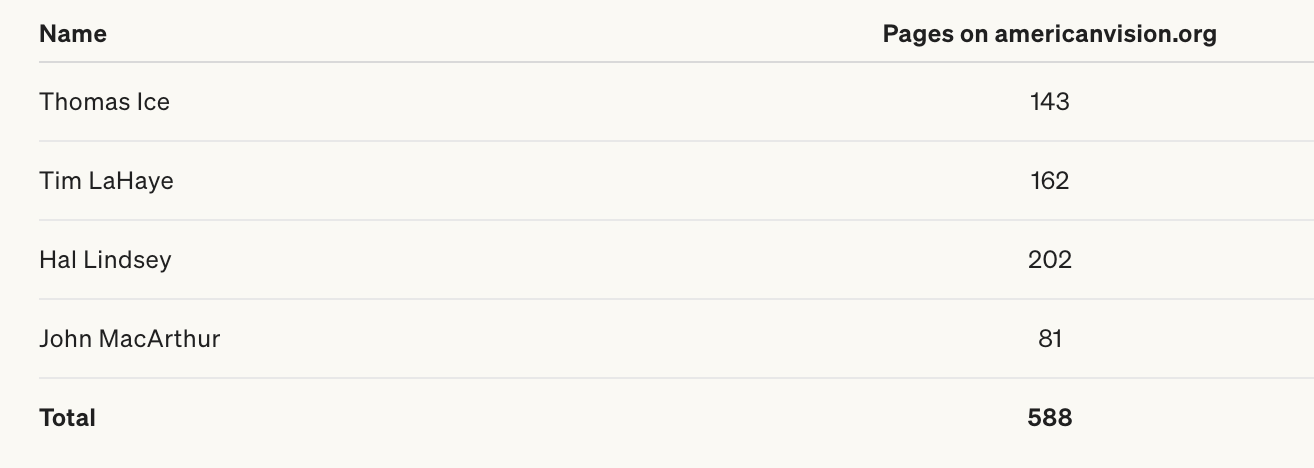
Read that again. Five hundred and eighty-eight pages mentioning just four people. And these are only four names. I didn't search for John Walvoord, Charles Ryrie, Jack Van Impe, Dave Hunt, Mark Hitchcock, or the dozens of other dispensationalists Gary has written about over the years. The real total is almost certainly north of a thousand pages dedicated to naming and critiquing specific individuals.
So Who Doesn’t Have a Life?
My 65 pages about DeMar are apparently evidence that I’m obsessed. But Gary’s 202 pages about Hal Lindsey? That’s just “ministry.” His 162 pages on Tim LaHaye? “Faithful theological work.” His 143 pages on Thomas Ice? “Important kingdom labor.”

The hypocrisy is breathtaking. Gary DeMar built his entire career at American Vision on one thing: naming, critiquing, and responding to dispensationalist theologians. That is what the site exists to do. And he makes money doing it. Page after page after page of “Here’s why Thomas Ice is wrong,” “Here’s why Hal Lindsey failed,” “Here’s why Tim LaHaye doesn’t understand eschatology.” That is the bread and butter. That is the brand.
And there’s nothing inherently wrong with that. If you believe someone is teaching theological error, you should say so publicly and make your case. That’s how theology works. Iron sharpens iron. But you don’t get to spend decades doing exactly that and then turn around and tell someone else they “wouldn’t have a life” for doing the same thing back to you. You don’t get to write two hundred pages about Hal Lindsey and then act like sixty-five pages about you is some kind of pathology.
The truth is, Gary doesn’t object to people building a body of work around critiquing a specific theologian. He objects to being on the receiving end of it. When he does it, it’s “contending for the faith.” When it’s done to him, the critic needs to “get a life.”
It's a silencing tactic. It's what false teachers do when they can't answer the critique, so they attack the critic instead. They want you to feel embarrassed for holding them accountable, to make you think something is wrong with you for paying attention to what they're teaching.
Don't let false teachers bully you into silence, especially you pastors out there who have had these troublemakers show up at your church, cause division in your flock, and then try to portray you as unloving when you confront them. You're not unloving. You're doing your job. You're shepherding. The moment a pastor is made to feel guilty for protecting his congregation from false teaching is the moment the wolves have already gotten inside the gate.