

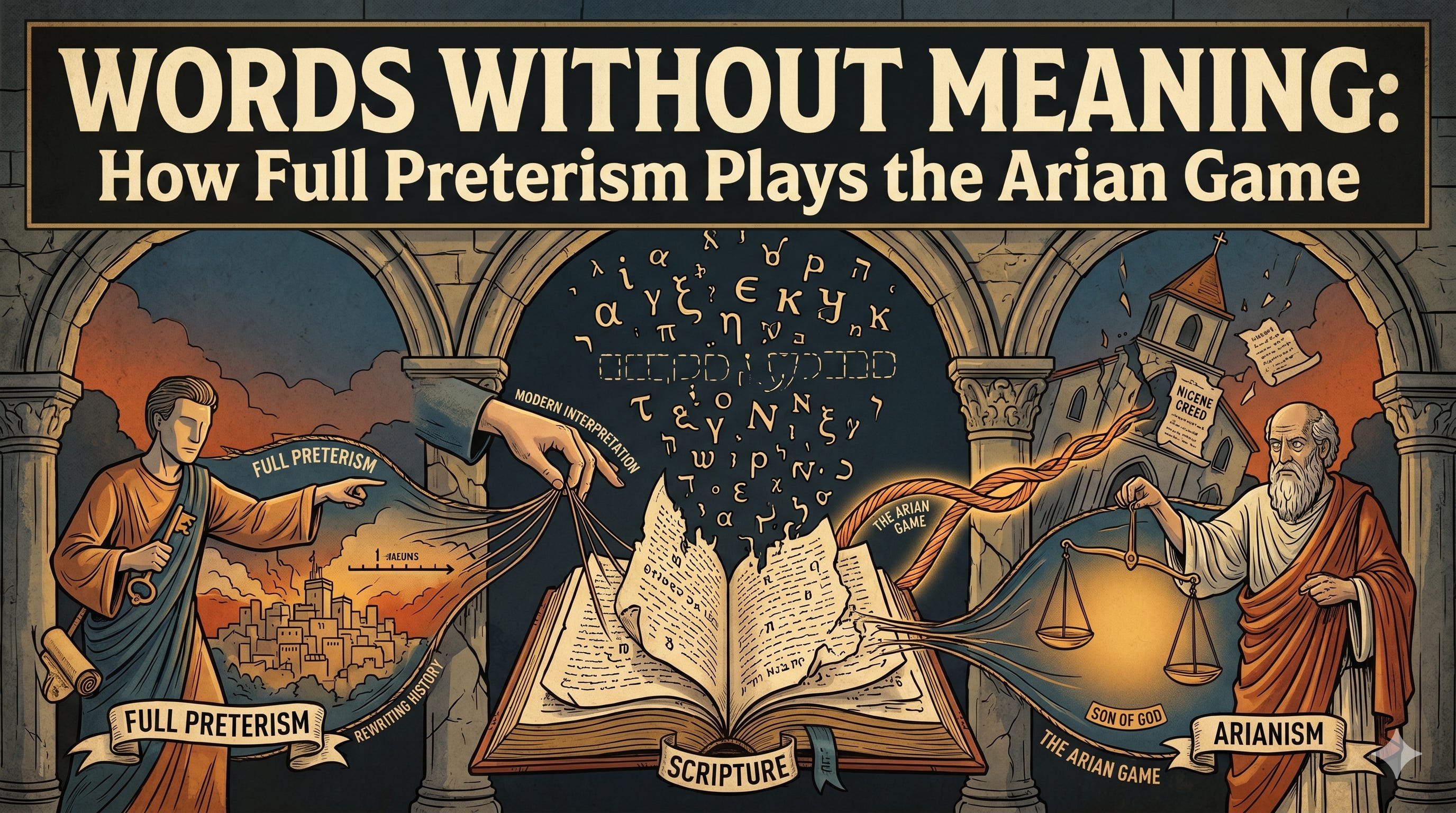
Matt Renfro has just provided, in real time, a textbook demonstration of the very thing that has been documented about Gary DeMar’s approach. He insists that “the orthodox position is simply the confession that Christ will come to judge the living and the dead, and that there will be a resurrection of the dead,” and then complains that qualifiers like “literal,” “physical,” “visible,” “future,” and “general” are not creedal language but “interpretive layers” being imposed on the text.
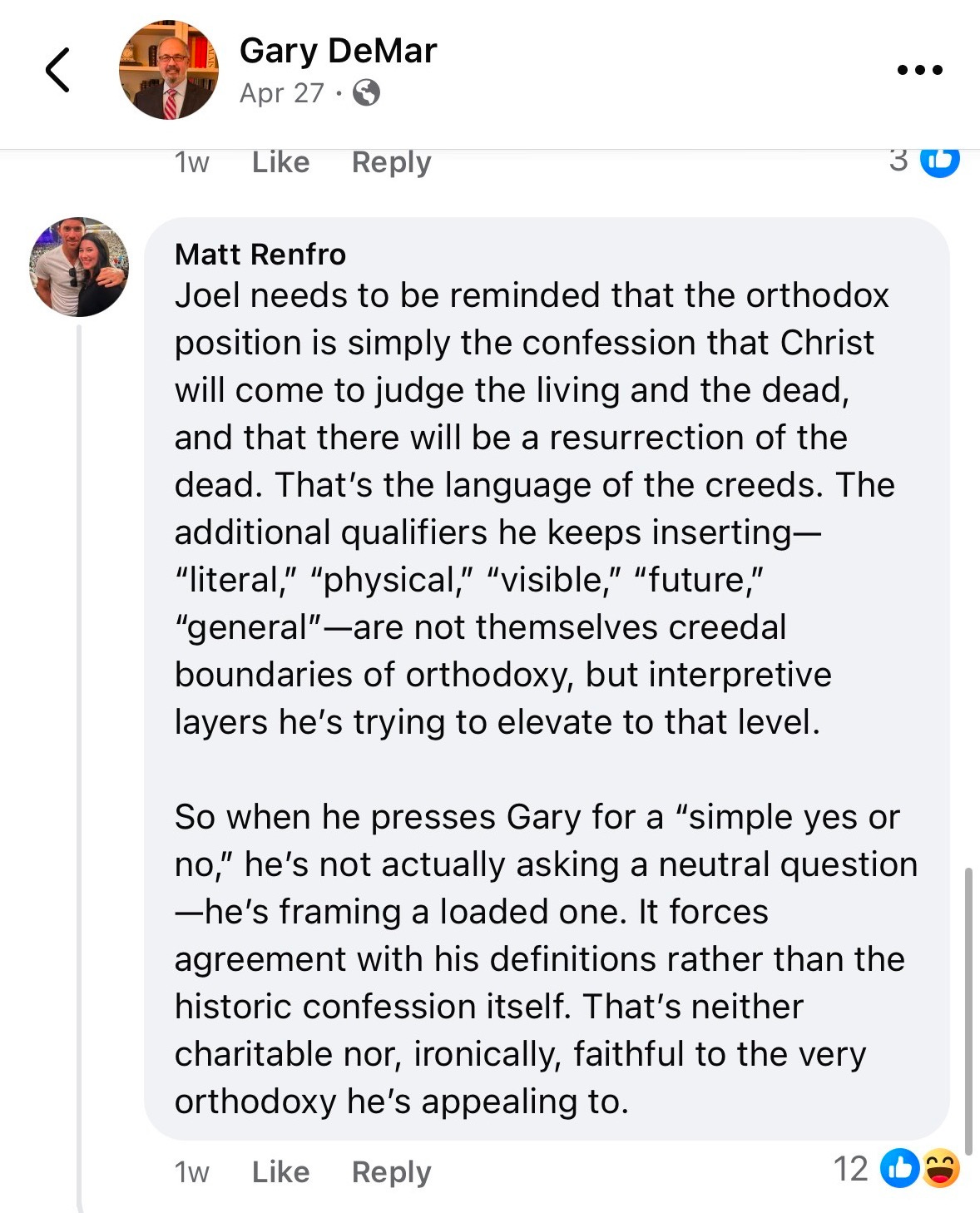
Think about what he is actually saying. He is saying you can affirm every word of the Creed, redefine every one of those words to mean something the framers never intended, and still be “orthodox” because you mouthed the right syllables. “Resurrection of the dead”? Sure, Matt will confess that, as long as “resurrection” can mean a metaphorical transition that already occurred in AD 70 and “the dead” need not refer to actual corpses coming out of actual graves. “He will come to judge the living and the dead”? Absolutely, as long as “come” does not mean a visible, bodily return and “judge” does not refer to a future event.
This is not orthodoxy. And it guts Christianity of all meaning. If affirming the bare words of a confession is sufficient regardless of the sense in which you hold them, then the door is thrown open to every cult that has ever parasitized Christian vocabulary. The Latter-day Saints confess faith in “Jesus Christ,” the “Son of God,” and the “Heavenly Father.” They use every one of those words. But in their system, both the Father and the Son are exalted, divinized mortal men, the Father possessing a body of flesh and bone, and Jesus being the literal biological offspring of that corporeal deity. Is Matt prepared to call Mormonism orthodox because they use the right words? If not, then he has already conceded the very principle he is contesting: that the meaning behind confessional language matters, not merely the recitation of it.
From a purely logical standpoint, this should not even need to be argued. A term that can be assigned any meaning whatsoever has no meaning at all. If “resurrection” in the creed can mean both a future bodily event and a past metaphor, then the word “resurrection” communicates nothing. It becomes an empty container that each party fills with whatever content they wish, and then both parties pretend they agree because the label on the container is the same. That is not confessional unity. That is equivocation.
R.C. Sproul addressed this problem directly:
There are compelling reasons why the church uses extrabiblical language to formulate biblical concepts. On the one hand, the church is forced to do so because heretics twist and distort biblical words to make them mean something other than what the Bible intended. It has always been the ploy of heretics to try and couch their doctrines in biblical language. Paul warns the Ephesians about this very thing:
Let no one deceive you with empty words, for because of these things the wrath of God comes upon the sons of disobedience (Eph. 5:6).
The “empty words” of which the Apostle writes are words that have been stripped of their meaning, drained of their genuine content. For centuries the church has had to battle against such misuse and abuse of language. The purpose of technical theological language is to achieve precision of meaning as well as to safeguard the flock from cunning and subtle distortions of doctrine.1
Matt might benefit from a glance at the actual history of the ecumenical creeds he claims to revere, because the councils faced this exact problem and rejected his reasoning explicitly.
Arius confessed that Christ was “God” and the “Son of God.” He used every creedal word available to him. But under scrutiny, Arius had redefined “God” so that it no longer meant eternal, uncreated Deity. Christ was “God” in Arius’s system only by a process of divine adoption, a creature elevated but a creature still. As R.C. Sproul put it: “If God no longer means eternal Deity, then God has become an empty word.”2 The orthodox fathers at Nicaea did not shrug and say, “Well, Arius confesses that Jesus is ‘God,’ and those additional qualifiers like ‘eternal’ and ‘uncreated’ are just interpretive layers we’re trying to elevate to creedal status.” No. They recognized that Arius was using the Church’s vocabulary while gutting it of the Church’s meaning, and they responded by introducing the term homoousios, “of the same substance,” precisely because bare creedal words had proven insufficient to exclude heretical redefinition. Sproul writes:
It was the Arian crisis of the fourth century that demonstrated so clearly the need for precise formulation of the doctrine of the Trinity. The chief ‘slippery snake’ of the controversy was a priest by the name of Arius. Arius confessed that Christ was ‘God’ and the ‘Son of God.’ However, under close scrutiny it was seen that Arius had redefined the word God so that it became virtually an empty term.3
This is precisely what is happening now. Full preterists affirm “resurrection” and “coming” and “judgment” while stripping every one of those terms of the content the framers of the creeds intended. And when someone asks for clarification, when someone insists on qualifiers like “physical” or “future” or “bodily,” they cry foul and accuse the questioner of going beyond the creeds. But it is not going beyond the creeds to insist on what the creeds meant. It is going beyond the creeds to smuggle in a meaning the creeds were designed to exclude.
Francis Turretin addressed this with characteristic precision:
The Symbol is not to be considered only with regard to the words, but as to the sense (because, as Hilary says, ‘The Scriptures do not consist in the reading but in the understanding’)... Therefore although heretics may say that they receive the Symbol, yet they do not because they reject its true and genuine sense. So Sabellius, Arius, Macedonius and other anti-Trinitarians formerly professed (to no purpose) in the words of the Symbol their faith in the Father, Son and Holy Spirit, while they endeavored to overthrow this very doctrine.4
And lest anyone suggest that “future” is merely an interpretive qualifier being imposed from outside the creedal tradition, consider the grammar of the Creed itself. It deliberately distinguishes between accomplished events, present realities, and anticipated ones. Christ “was crucified,” “suffered,” “was buried,” and “rose again,” all past tense, reporting completed history. He “ascended into heaven,” past, and “sits at the right hand of the Father,” present reality. But then the Creed shifts to what has not yet occurred: “He shall come again with glory to judge both the quick and the dead,” and “we look for the resurrection of the dead, and the life of the world to come.” Notice that last phrase carefully. “We look for the resurrection of the dead.” You do not look for something that has already arrived. Nobody “looks for” last Tuesday. The framers of the Creed were perfectly capable of distinguishing past events, present realities, and future expectations, and they did so deliberately within the same confession. The futurity of the Second Coming and the resurrection is not an external imposition on the creedal tradition. It is embedded in the very grammar of the confession itself.
So when Matt accuses anyone of imposing “interpretive layers” on the creeds by asking whether “resurrection” means a future, physical, bodily event, he is not defending the creeds. He is defending the right to hollow them out. He is defending the Arian playbook. He is doing in the 21st century with eschatology exactly what Arius did in the 4th century with Christology: confessing the words, denying the substance, and then accusing the orthodox of overreach for insisting the words actually mean something.
The qualifiers “literal,” “physical,” “visible,” “future,” and “general” are not foreign intrusions into the creedal tradition. They are the homoousios of this debate: the terms the orthodox are forced to employ because men like Matt have demonstrated that bare creedal language, left undefined, becomes a hiding place for heterodoxy. Calvin saw this clearly:
Such novelty (if novelty it should be called) becomes most requisite, when the truth is to be maintained against calumniators who evade it by quibbling. Of this, we of the present day have too much experience in being constantly called upon to attack the enemies of pure and sound doctrine. These slippery snakes escape by their swift and tortuous windings, if not strenuously pursued, and when caught, firmly held. Thus the early Christians, when harassed with the disputes which heresies produced, were forced to declare their sentiments in terms most scrupulously exact in order that no indirect subterfuges might remain to ungodly men, to whom ambiguity of expression was a kind of hiding-place. Arius confessed that Christ was God, and the Son of God; because the passages of Scripture to this effect were too clear to be resisted, and then, as if he had done well, pretended to concur with others. But, meanwhile, he ceased not to give out that Christ was created, and had a beginning like other creatures. To drag this man of wiles out of his lurking-places, the ancient Church took a further step, and declared that Christ is the eternal Son of the Father, and consubstantial with the Father. The impiety was fully disclosed when the Arians began to declare their hatred and utter detestation of the term ὁμοούσιος. Had their first confession, viz., that Christ was God, been sincere and from the heart, they would not have denied that he was consubstantial with the Father. Who dare charge those ancient writers as men of strife and contention, for having debated so warmly, and disturbed the quiet of the Church for a single word? That little word distinguished between Christians of pure faith and the blasphemous Arians.5
Matt does not get to redefine every term in the Creed and then claim the Creed as his own. That is not how confessions work. That is not how language works. That is not how logic works. And the entire history of the ecumenical councils stands as a monument to the fact that the Church has always known it.
R. C. Sproul, “The Mystery of the Holy Spirit” (Ross-shire, Scotland: Christian Focus; Lake Mary, FL: Ligonier Ministries, 1990), p. 33.
Ibid., p. 34.
Ibid., p. 34.
Francis Turretin, Institutes of Elenctic Theology, ed. James T. Dennison Jr., trans. George Musgrave Giger, vol. 1 (Phillipsburg, NJ: P&R Publishing, 1992), 1.14.22.
John Calvin, Institutes of the Christian Religion (Bellingham, WA: Logos Bible Software, 1997), 1.13.4.