

I came across a piece on Substack from Darren Doane arguing that the entire New Testament should be read in light of AD 70, including 1 Corinthians. Doane is a good friend of Gary DeMar and appears to have gone the full preterist route.
One text he comments on is 1 Corinthians 7. Paul writes, “I think that in view of the present distress it is good for a person to remain as he is” (7:26). “Are you free from a wife? Do not seek a wife” (7:27). “The appointed time has grown very short” (7:29). “The present form of this world is passing away” (7:31). Doane’s reading is that Paul is not disparaging marriage but, in his own words, is “pastoring in a storm.” With revolt brewing in Judea and Rome on the move, he says, the late sixties would bring hunger, displacement, and seized property, so telling young believers to think hard about vows and households was sound pastoral counsel.
It does not work.
I say that as someone who used to say the same thing. Back in 2002 I ran this very experiment, taking the whole New Testament and running it through AD 70, and I would have written these paragraphs myself. What strikes me now is how oblivious I was to problems that surface the moment you slow down and ask whether the reading actually fits the text in front of you.
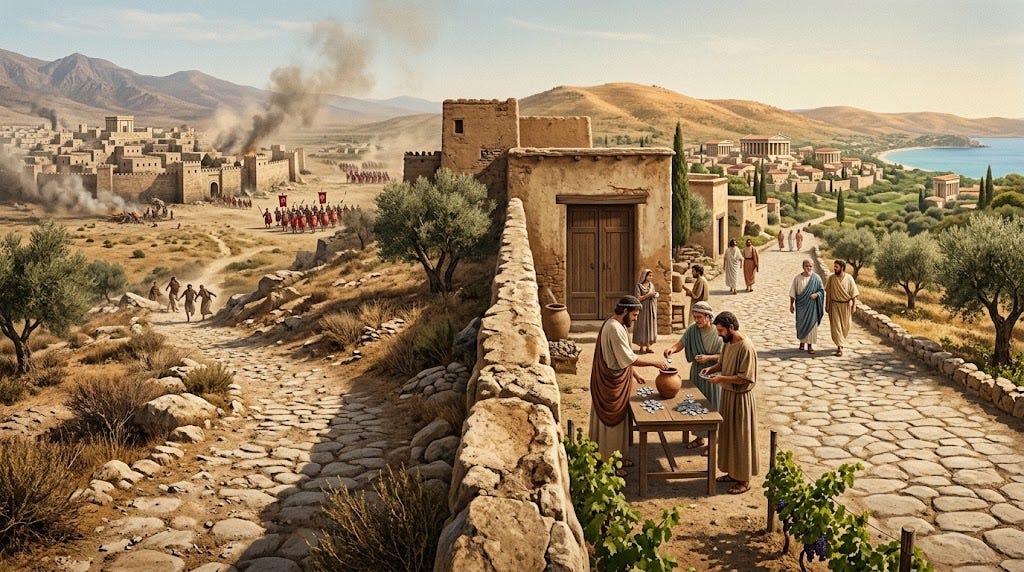
Doane is correct that there is a section of Matthew 24 dealing with the abomination of desolation and a flight from Judea that concerns the first century. Jesus was giving evacuation orders for a specific population, not general advice for a distant doomsday. “Then let those who are in Judea flee to the mountains” (Matthew 24:16), and Luke ties it directly to seeing Jerusalem surrounded by armies. I do not grant that all of Matthew 24 refers to AD 70, but that portion does.
Which is exactly why Corinth cannot be brought under it. The warning names a place, and Corinth is not that place. It sits roughly seven hundred miles from Jerusalem, across the Aegean, in the province of Achaia, a Roman colony the Jewish War never touched.
And notice that the command itself rules out the wider reading. Flight only makes sense if there is somewhere safer to go. If the danger spilled out beyond Judea so that believers in Achaia had to restructure their households around it, then telling Judeans to run for the mountains was pointless counsel. Run where? The whole force of “flee” depends on the trouble being local and the outside being safe.
And Paul tells us plainly what the Corinthians were doing with their money. “On the first day of every week, each of you is to put something aside and store it up” (1 Corinthians 16:2), to be carried “to Jerusalem” (16:3). Romans 15:26 names Achaia, Corinth’s own province, among those who gave. They were not selling off assets to stay mobile. They were saving, week after week, and sending it into the one city Doane says was about to be the worst place on earth to keep anything.
Good post, just one point of disagreement: last I talked to him, Darren is not full preterist. Yes he is a friend of Gary, but he is not saying anything in his post about eliminating any references to the final judgment.