

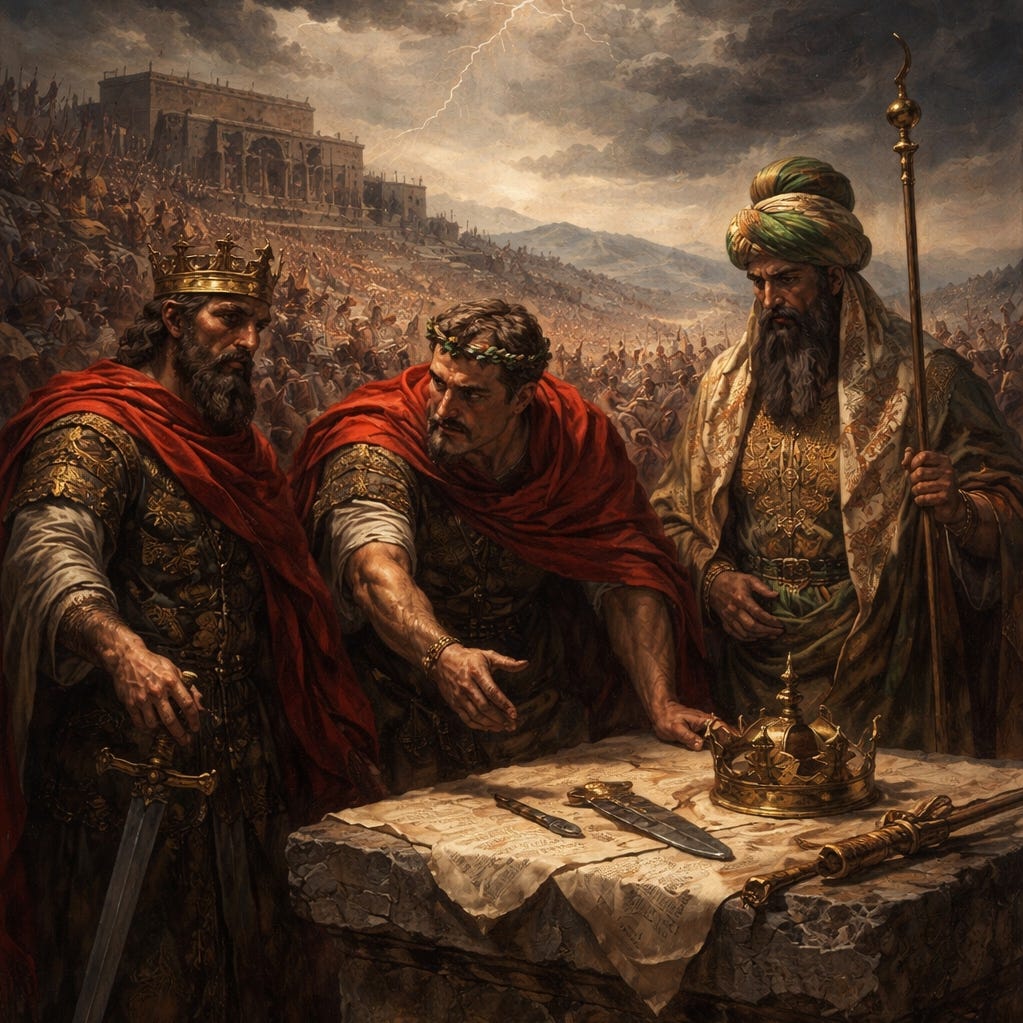
In the providence of God, our Scripture readings this past Lord’s Day were Psalm 2 and Matthew 27. I offered some brief comments at the time, especially noting how Psalm 2:1–2 unfolds historically in the trial and crucifixion of Christ.
Why do the nations rage and the peoples plot in vain? The kings of the earth set themselves, and the rulers take counsel together, against the LORD and against his Anointed. (Psalm 2:1–2, ESV)
When we turn to Matthew 27, we are not left to guess what that looks like in history. There stands Pontius Pilate, the Roman governor. There are the chief priests and elders of Israel. There is the crowd stirred up to cry, “Let him be crucified.” Jew and Gentile, civil ruler and religious authority, people and princes, all converging in a single moment of rebellion against the Lord’s Anointed.
Calvin is emphatic that Psalm 2 ultimately speaks of Christ. David’s kingdom was a shadow. The substance is the mediatorial reign of the Son. When rulers set themselves against the Anointed, they are not merely resisting a human king. Calvin writes that “all who do not submit themselves to the authority of Christ make war against God.”1 He grounds this in John 5:23. To refuse the Son is to refuse the Father.
Matthew 27 shows us Psalm 2 in action. The rulers of the earth did in fact “take counsel together.” They examined Him, mocked Him, handed Him over, and nailed Him to the cross. From a merely political perspective, it looked like a straightforward exercise of state power and religious expediency. From heaven’s perspective, it was open rebellion against the decree of God.
Yet Psalm 2 had already told us how heaven responds. “He who sits in the heavens laughs; the Lord holds them in derision” (Psalm 2:4, ESV). Calvin explains that God’s laughter does not mean indifference. It means sovereignty. The raging of kings does not threaten the throne of heaven. Even when Christ stands silent before Pilate, the decree stands: “I have set My King on Zion, My holy hill” (Psalm 2:6, ESV).
The cross was not the frustration of that decree. It was its pathway. As Calvin observes, the “begetting” spoken of in Psalm 2:7 is publicly manifested in the resurrection. Paul in Acts 13:33 connects the declaration “You are My Son” to the risen Christ. The rulers thought they had ended His claim. In truth, they were participating in the very plan that would enthrone Him in glory.
All of this bears directly on the modern claim that rulers and magistrates are somehow exempt from the “religion” of Christianity. We are told that politics must be neutral, that faith is private, and that civil authority stands in a separate sphere untouched by the lordship of Christ.
Psalm 2 will not allow that fiction. The psalm addresses “kings” and “judges of the earth” in their official capacity. It does not say, Believe in your heart but govern as if Christ is irrelevant. It commands them, “Serve the LORD with fear” and “Kiss the Son” (Psalm 2:11–12, ESV). Calvin underscores that David “spare[s] not even kings themselves.” Princes imagine that their exalted station exempts them from obedience. The psalm exposes that as folly.
The scene in Matthew 27 demonstrates that there is no neutral ground. Pilate did not crucify a merely private religious teacher. He rendered a political judgment against a man accused of kingship. The charge placed over Christ’s head was explicitly royal: “This is Jesus, the King of the Jews” (Matthew 27:37, ESV). The question at the center of the trial was not simply theological. It was political. Who is King?
The answer given by heaven in Psalm 2 is clear. God has installed His King. The nations may rage, but they cannot annul the decree. The rulers may consult together, but they cannot dethrone the Son.
This is precisely the framework assumed in the original Westminster Confession of Faith on the civil magistrate. The magistrate is ordained by God and accountable to Him. He is not the head of the church, and he may not assume the keys of the kingdom. Christ’s kingdom is spiritual, advanced by the Word and Spirit, not by the sword. Yet the magistrate is not religiously autonomous. He is a minister of God for good, and he is bound to govern in accordance with God’s revealed will.
To say that rulers are exempt from Christianity is to say that Psalm 2 does not apply to them. But the psalm is addressed to them. It calls them to wisdom, to fear, to homage. Calvin’s language is sharp. Those who refuse to submit to Christ are rebels against God, whatever pious language they may use to mask it.
This does not mean that the state can create faith, or that the church and state are to be confused. Christ does not conquer by our coercion. Calvin is clear that He breaks His enemies “by the breath of His mouth.” His rod is His Word. The kingdom spreads by preaching, not by compulsion.
Yet none of that softens the universal claim of Christ’s lordship. The risen Son of Psalm 2 is the crucified King of Matthew 27. The One mocked by soldiers now reigns at the right hand of the Father. Every magistrate governs under Him. Every president, king, and judge will answer to Him.
Psalm 2 ends not only with warning but with promise: “Blessed are all who take refuge in Him” (Psalm 2:12, ESV). That blessing is not limited to private citizens. It is extended to rulers as well. The call is not for them to shed their office, but to exercise it in humble submission to the Son.
Matthew 27 shows us what happens when rulers join the rage of the nations. Psalm 2 shows us what wisdom looks like instead. Serve the LORD with fear. Kiss the Son. Take refuge in Him before His wrath is kindled.
There is no neutral throne in a world where Christ is risen.
Calvin, John, and James Anderson. 2010. Commentary on the Book of Psalms. Vol. 1. Bellingham, WA: Logos Bible Software.