

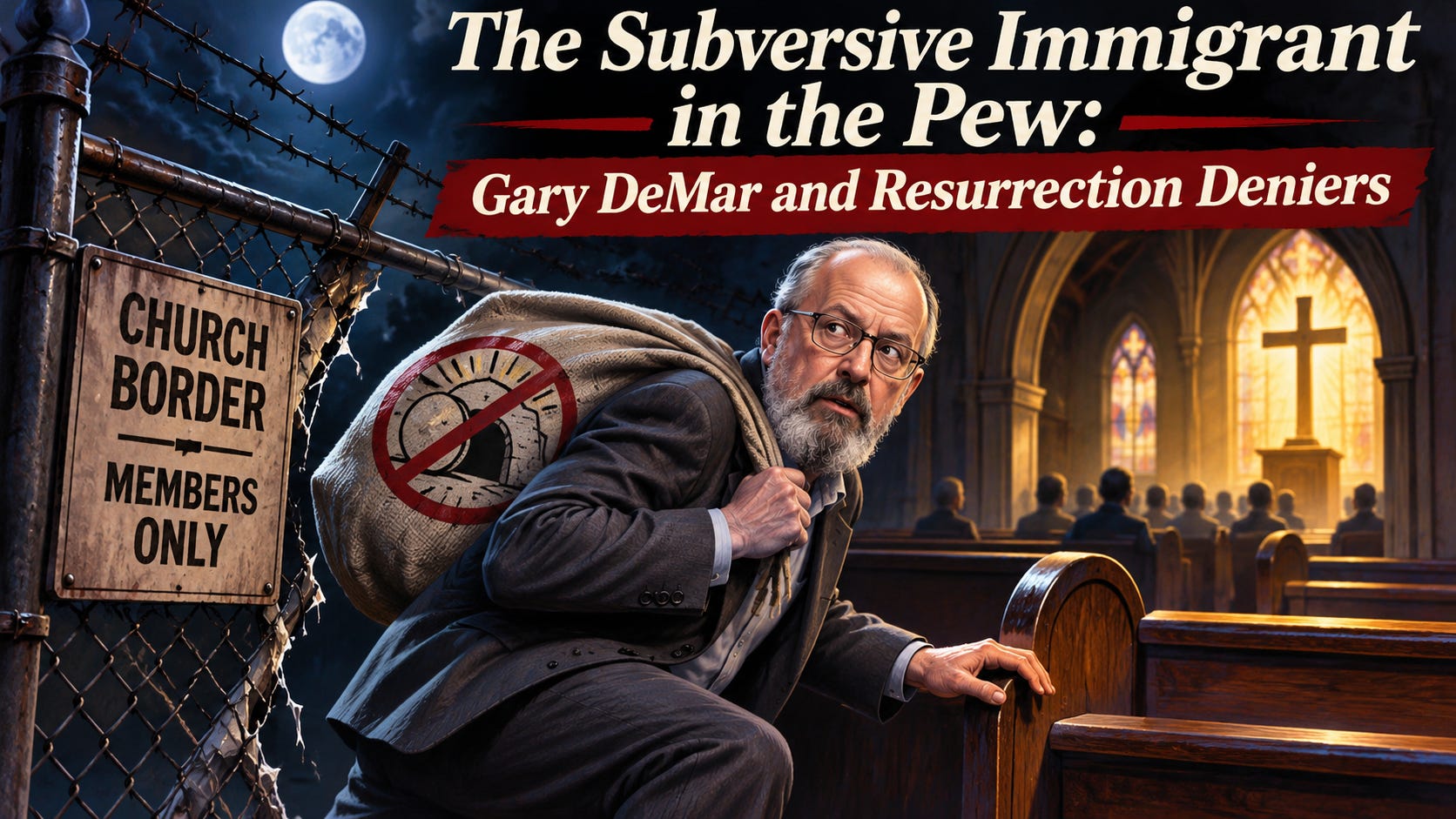
In April 2019, Mark Ruffalo told his followers on Easter that Jesus was an “illegal immigrant.” Gary DeMar answered him at American Vision. He cited Exodus 12:49 and Leviticus 24:22 and argued that when America’s laws were biblically based, even the unbeliever “was bound by the laws of the land.”1 His objection was not to immigrants who come under the law. It was to those who come to live off the welfare state, to gangs, and to Islamist radicals who may be crossing for other purposes. The stranger is welcome, but the stranger is not exempt from the law.
DeMar is right about that, and the same principle applies to him. The church has a constitution, and DeMar has refused to come under it.
American Vision’s own staff profile says DeMar and his wife are members of Midway Presbyterian Church, a congregation of the PCA.2 Communicant membership in the PCA carries the obligations of the membership vows in its Book of Church Order (57-5). The fourth asks members to promise to support the church “in its worship and work.” The fifth asks them to submit to the government and discipline of the church and to “study its purity and peace.”3 These vows are the church’s version of a naturalization oath. They do not make a man an officer, and they do not require him to subscribe to the Westminster Confession line by line. They do require him to support the faith of the church he joined and not work against it.
The texts DeMar used against Ruffalo make this point more strongly than he noticed. Exodus 12:49 reads, “There shall be one law for the native and for the stranger who sojourns among you.”4 The Hebrew is tôrâ ʾaḥat, one torah, binding the ʾezrāḥ, the native-born, and the gēr, the resident alien.5 Leviticus 24:22 says the same with mišpaṭ ʾeḥād, one rule of judgment. But Exodus 12:49 concludes the regulations governing the Passover, and the verse before it reads: “If a stranger shall sojourn with you and would keep the Passover to the LORD, let all his males be circumcised. Then he may come near and keep it; he shall be as a native of the land. But no uncircumcised person shall eat of it” (12:48). The native Israelite and the resident alien were under the same law. The stranger who wished to keep the Passover could do so and was received “as a native of the land,” but only by meeting the covenant’s requirement. He was welcomed, but the terms of participation were not his to change.
The church DeMar joined is clear on the resurrection. The Confession teaches that the souls of the righteous go to heaven at death, “waiting for the full redemption of their bodies” (WCF 32.1). At the last day, “all the dead shall be raised up, with the self-same bodies, and none other, (although with different qualities,) which shall be united again to their souls for ever” (WCF 32.2). The church has always confessed the resurrection of the body in the Creed. DeMar and Kim Burgess teach otherwise. Their book, The Resurrection of the Dead: The Mortal Swallowed Up by Life, denies that the self-same body that dies will be raised,6 and DeMar makes plain throughout that he affirms what Burgess teaches. He has said the same in his own words. Asked in a 2022 interview what will happen to him when he dies, he answered that he will receive a new body at death.7 The Confession answers both claims. The soul goes to God at death, the body waits for the last day, and the body raised is the body that died.
DeMar knows how much is at stake. In his book with Burgess he writes, “The resurrection of the dead is central to Christian theology.”8 He calls the doctrine central and then teaches something contrary to it under the same name. By the standard of his own 2019 article, that is exactly what a newcomer may not do. The stranger lives under the law of the land he enters; he does not rewrite it. And DeMar’s case is worse than the illegal immigrant’s. The man who crosses the border to change a country never promised to keep its laws. DeMar promised, when he joined, to support the church and submit to its government.
Paul does not treat the resurrection of the dead as a side issue. In 1 Corinthians 15 he answers some who “say that there is no resurrection of the dead” (15:12), and he shows that their denial takes Christ’s resurrection down with it: “If there is no resurrection of the dead, then not even Christ has been raised” (15:13). The stakes are personal. If the resurrection is denied, “your faith is futile and you are still in your sins” (15:17). The Corinthians are being saved, Paul says, “if you hold fast to the word I preached to you” (15:2).
Paul also named men who said the resurrection was already past. “Their talk will spread like gangrene. Among them are Hymenaeus and Philetus, who have swerved from the truth, saying that the resurrection has already happened. They are upsetting the faith of some” (2 Tim. 2:17-18). These men did not drop the word resurrection. They kept the word and changed its meaning. Paul uses the perfect infinitive gegonenai with the adverb ēdē, “already,” to state their claim that the resurrection was a finished event. That is precisely the claim full preterism makes. Paul says these men ēstochēsan, missed the mark.9 He says they anatrepousin, overturn, the faith of some, the same verb John uses when Jesus overturned the money changers’ tables (John 2:15).10 And he compares their teaching to gangraina, gangrene, which spreads and destroys healthy tissue..11
Jude warned the church about men who had “crept in unnoticed” (Jude 4). His verb, pareisedusan, describes a secret entrance.12 The danger was not only their presence but the teaching they brought among God’s people. DeMar’s teaching is not hidden. It is published, promoted, and sold under his own name. The question is not whether the church can recognize the error, but whether it will address it.
Their attitude toward the church is not hidden either. Every country knows a certain kind of newcomer. He has not come to live under the law but to replace it, and while he works at it he speaks of peace, tolerance, and getting along. Now and then his mouth gives him away, and you hear what he really thinks of the country he lives in. Burgess and DeMar fit that pattern. On page 185 of their book, DeMar lays down a rule: “We have no call and no right to attack and derisively label one another” over the doctrine of the resurrection.13 Yet the book does not keep the rule. Burgess says the English translators of 1 Corinthians 15:26 changed the tense in a way that “borders on deceit,” charges the Westminster Assembly with “crippling self-imposed theological blindness,” and calls the confessions “shoddy and weak.” Eighty pages after writing his rule, DeMar himself says that placing 2 Thessalonians 1 in the future “is insanity!”14 That is how the authors speak of the church’s translators, its confession, and every Christian who confesses with it that the body laid in the grave will rise.
The psalmist knew the type. “His speech was smooth as butter, yet war was in his heart; his words were softer than oil, yet they were drawn swords” (Ps. 55:21). The Hebrew sets the two halves against each other: the words of his mouth are ḥālqû, smooth, but his heart is qĕrāb, war. David is not describing an enemy outside the gates. He is describing a companion with whom he “used to take sweet counsel,” with whom he “walked in the throng” in God’s house (55:14). The danger he names comes from inside the congregation. Jesus gave the rule for telling which part is true: “out of the abundance of the heart the mouth speaks” (Matt. 12:34). The plea for peace on page 185 is the smooth speech. The insults on the pages around it show what is in the heart.
Furthermore, Paul ties the Christian’s citizenship to the resurrection hope DeMar will not affirm. “Our citizenship is in heaven, and from it we await a Savior, the Lord Jesus Christ, who will transform our lowly body to be like his glorious body” (Phil. 3:20-21). The word is politeuma, the commonwealth we belong to,15 and Paul attaches to it a future change in the body: Christ metaschēmatisei, will transform, to sōma tēs tapeinōseōs hēmōn, the body of our humiliation. What is transformed is the body, and it happens when the Savior comes. Ephesians calls believers no longer strangers and aliens but sympolitai, fellow citizens with the saints (Eph. 2:19), members of a household “built on the foundation of the apostles and prophets” (2:20).
Paul also shows what happens to a man who will not stand on that foundation. Hymenaeus, whom he names in 2 Timothy for saying the resurrection had already happened, is almost certainly the same Hymenaeus of 1 Timothy 1:20. There he is one of those who “made shipwreck of their faith,” and Paul says he has “handed [them] over to Satan.” That phrase, paredōka tō Satana, is the formula Paul uses for putting a man out of the church (1 Cor. 5:5). Denying the resurrection does not leave a man a citizen in good standing who holds an unusual opinion. It puts him outside the household, and if he persists, it shows that his profession was never the faith that saves (1 John 2:19).
That is why the remedy belongs to the church. If DeMar is still a member of Midway, as his own ministry says, his standing is for its session to judge. And if Midway’s session has not dealt with this biblically, shame on Midway. Paul wrote the same word to a church that tolerated resurrection deniers in its midst: “Some have no knowledge of God. I say this to your shame” (1 Cor. 15:34). Christ’s charge against Thyatira was not that a false teacher existed, but “I have this against you, that you tolerate” her (Rev. 2:20). If DeMar has left Midway, he should say so instead of letting his ministry present him as a member of a confessional Presbyterian church. Either way, we owe him a plain call to repent, and we owe his readers Jude’s charge to “contend for the faith that was once for all delivered to the saints” (Jude 3). Hapax, once for all, means the faith was delivered whole and is not open to revision.
A man who rejects his country’s laws is free to leave. He is not free to stay, keep the privileges of citizenship, and work from inside to replace the law he was received under. DeMar’s own 2019 article would not exempt that man from the law, and he is that man in the church. Exodus 12 let the stranger keep the Passover only on the covenant’s terms. DeMar wants a place at the table on his own. He is free to leave and answer to God for a different gospel. He is not free to keep the name of a member and use it to change the faith his church confesses.
Gary DeMar, “Was Jesus an Illegal Immigrant and a Palestinian?” The American Vision, April 26, 2019, https://americanvision.org/18462/was-jesus-an-illegal-immigrant-and-a-palestinian/.
“Meet Gary DeMar,” The American Vision, accessed November 5, 2026, https://americanvision.org/about/staff-profiles/.
Presbyterian Church in America, The Book of Church Order of the Presbyterian Church in America, 57-5, accessed November 5, 2026, https://www.pcaac.org/bco/.
Unless otherwise noted, Scripture quotations are from the ESV® Bible (The Holy Bible, English Standard Version®), copyright © 2001 by Crossway.
Ludwig Koehler and Walter Baumgartner, The Hebrew and Aramaic Lexicon of the Old Testament, trans. and ed. M. E. J. Richardson (Leiden: Brill, 1994–2000), s.v. “ʾezrāḥ” and “gēr.”
Kim Burgess with Gary DeMar, The Resurrection of the Dead: The Mortal Swallowed Up by Life (Powder Springs, GA: American Vision, 2026), 36.
Gary DeMar, interview by the Burros of Berea, October 27, 2022, at approximately 1:29:00, clip in Jason L. Bradfield, “Gary DeMar Denies the Resurrection of the Body,” Reformed Ember Lounge, March 22, 2023, https://www.reformation.blog/p/gary-demar-denies-the-resurrection.
Burgess with DeMar, Resurrection of the Dead, vii.
Walter Bauer, A Greek-English Lexicon of the New Testament and Other Early Christian Literature, 3rd ed., rev. and ed. Frederick William Danker (Chicago: University of Chicago Press, 2000), s.v. “astocheō.”
Bauer, Greek-English Lexicon, s.v. “anatrepō.”
Bauer, Greek-English Lexicon, s.v. “gangraina.”
Bauer, Greek-English Lexicon, s.v. “pareisdyō.”
Burgess with DeMar, Resurrection of the Dead, 185.
Burgess with DeMar, Resurrection of the Dead, 61, 68, 143, 266. For the fuller record, including their earlier statements in The Hope of Israel and the Nations, see Jason L. Bradfield, “Deceitful, Blind, Insane Goats: Kim Burgess and Gary DeMar on Charity,” Reformed Ember Lounge, November 3, 2026, https://www.reformation.blog/p/deceitful-blind-insane-kim-burgess.
Bauer, Greek-English Lexicon, s.v. “politeuma.”